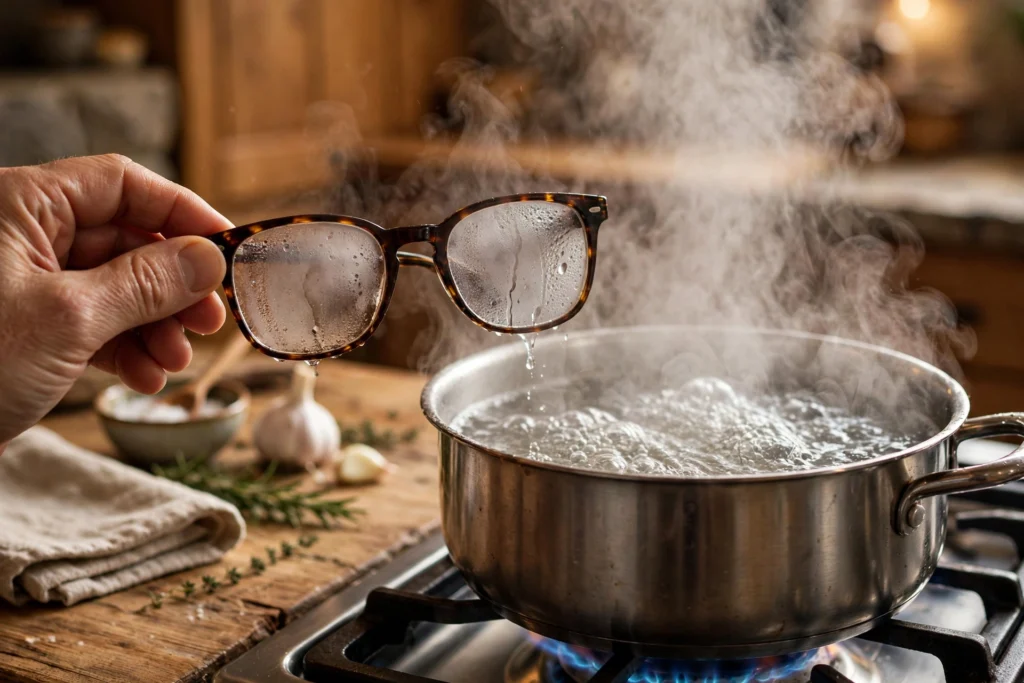
Every time I lean over a pot of boiling pasta, the same thing happens: a white curtain drops over my glasses and I can’t see whether the water is boiling over or the onions are burning. I’ve cooked entire meals half-blind, lifting my glasses off my face to check the pan like some kind of kitchen periscope. It took me an embarrassingly long time to realize this wasn’t something I just had to accept. Here’s how to stop glasses fogging up when cooking for good.
If you’ve been searching for how to stop glasses fogging up when cooking, this guide is for you. The fog is annoying, but it’s also genuinely hazardous — nobody should be wielding a knife or draining boiling water they can’t see. I’ve tested the common tricks people swear by and sorted out which ones actually work in a hot, steamy kitchen.
Table of Contents
Why Cooking Fogs Up Your Glasses — and How to Stop Glasses Fogging Up When Cooking
The cause is simple physics. Fog on your lenses is condensation: warm, moist air hits a cooler surface, and the water vapor turns into thousands of tiny droplets that scatter light. FramesDirect’s guide to foggy lenses explains this well — whenever the air around your lenses is warmer and more humid than the lens surface itself, condensation forms.
Cooking creates the perfect storm for this. A boiling pot or a hot oven sends up a continuous plume of steam. You lean in close to stir, check, or taste, and your face — and your lenses — pass right through that warm, damp air. Your glasses, which are usually at room temperature or cooler, are the coldest surface in the path of the steam. The vapor hits them, condenses instantly, and your view of dinner disappears.
Knowing the mechanism matters, because every fix below works on one of two principles: either stop the steam from reaching your lenses, or treat the lenses so condensation can’t form properly. Use them together to stop glasses fogging up when cooking for good.
1. The Dish Soap Trick (My Favorite)
This is the fix I use every single day. Put a tiny drop of plain dish soap — not the moisturizing kind — on each lens, rub it gently over both sides with your fingertip, then buff it off with a clean, dry microfiber cloth. You’re not trying to leave the lens soapy; you’re leaving an ultra-thin, invisible film that changes how moisture behaves on the surface. Instead of beading into thousands of light-scattering droplets, the vapor spreads into a thin, transparent layer you can barely notice.
One important caution: don’t use soaps with lotions, and don’t scrub hard. Some lens coatings can be sensitive to household chemicals, so test this on an old pair first or check with your optician. Applied gently, though, this is the single most effective trick I found. It’s my go-to way to stop glasses fogging up when cooking every day.
2. Adjust How Your Glasses Sit on Your Nose
Fogging gets worse when your glasses sit high and tight, trapping a pocket of warm air between your face and the lenses. Pushing your frames slightly down your nose creates a gap that lets air circulate. It feels odd at first if you’re used to wearing them high, but that small airflow channel makes a real difference over a steaming pot.
If your glasses constantly slide down, the nose pads might need adjusting — most opticians will adjust frames for free. It’s worth doing, because a better fit helps with more than just cooking fog.
3. Tilt Your Head Instead of Leaning In
This is embarrassingly simple and it works. Most of the steam rises straight up from the pot. When you lean directly over it, your face and glasses intercept the full column of vapor. If you stand slightly to the side and tilt your head down to look into the pot at an angle, most of the steam misses your lenses entirely.
I started doing this when stirring anything that produces a lot of steam — boiling water, stir-fries, anything with a lid I just lifted. It won’t fix every situation, but it cuts the worst of the fogging without any equipment at all.
4. Use an Anti-Fog Spray or Pre-Treated Wipes
If the dish soap trick feels too DIY, commercial anti-fog sprays and pre-treated microfiber wipes do the same job in a more controlled way. These products contain surfactants — the same class of ingredient that makes soap work — designed specifically for optical lenses. Spray, buff, and you get a few hours of fog resistance.
The downside is that they wear off and need reapplying, and you have to keep buying them. For occasional cooks, a pack of pre-treated wipes in the kitchen drawer is a decent low-effort option. For daily cooking, I find the dish soap method just as effective and far cheaper.
5. Turn Up the Range Hood (or Open a Window)
The best way to stop steam reaching your lenses is to remove the steam from the air entirely. If your range hood has a fan, run it on full while you cook — it captures the rising vapor before it ever reaches your face. I’ve cooked in kitchens where the hood fan was left off out of habit, and the difference in lens fogging (not to mention general steaminess) is dramatic.
No range hood? Crack a window near the stove. Cross-ventilation pulls the steam away and keeps the kitchen air less saturated. It also keeps the whole kitchen more comfortable.
6. Let Pots Vent Before You Lean In
That blast of steam when you lift a lid is the worst offender. It shoots straight up in a concentrated burst — exactly into the face of whoever lifts the lid. The fix: lift the lid away from you, tilted so the steam escapes to the side, and wait a few seconds before leaning in. Count to five. The initial blast dissipates, and the remaining steam is much weaker.
I also do this with the oven — open it, step back for a moment, then look in. Five seconds of patience saves you from cooking blind.
7. Consider Anti-Fog Lens Coatings at Your Next Eye Exam
If you cook daily and you’re due for new lenses anyway, ask your optician about anti-fog coatings. These are factory-applied treatments that make the lens surface spread moisture into a thin film rather than droplets — the same principle as the dish soap trick, but built into the lens and far more durable.
They usually cost extra, so it’s not worth replacing perfectly good lenses for this alone. But if you’re buying new glasses anyway, it’s worth adding to the list of coatings alongside anti-reflective and scratch-resistant.
8. Keep Your Lenses Spotless
Dirty lenses fog faster. Dirt, fingerprints, and oily residue create an uneven surface where moisture collects more easily and forms visible droplets. Clean lenses with a proper lens cleaner or a drop of dish soap in water, rinsed and dried with a microfiber cloth, give the anti-fog treatments less to fight against.
This is a compounding fix: clean lenses make trick #1 (the dish soap film) and trick #4 (anti-fog spray) work noticeably better. I clean mine every morning, and on heavy cooking days I give them a quick wipe before I start.
9. Switch to Contacts for Big Cooking Sessions
I’ll be honest — this is the nuclear option, and it’s not for everyone. But if you’re someone who cooks for hours, say during holiday meal prep or batch cooking, contact lenses sidestep the problem entirely. No lenses, no fog.
I don’t wear contacts regularly, but a friend who does all her family’s holiday cooking in them swears it’s the one time of year she appreciates them most. If you already wear contacts occasionally, save them for the big cooking days.
What Doesn’t Work Well
A few popular suggestions that disappointed me:
- Just wiping the fog away. The steam is continuous, so the fog returns within seconds. You end up in an endless wipe-fog-wipe loop.
- Shaving cream on the lenses. This gets recommended online a lot, but many lens manufacturers and optometrists warn against it — it can damage lens coatings, and it leaves residue that’s hard to remove cleanly.
- Breathing “downward” while cooking. You’re not fogging your lenses with your breath when you cook; the steam from the food is the problem. Breath-control tricks help with face masks, not with boiling pots.
The 30-Second Version
If you take away three things: treat your lenses with a thin film of dish soap before you cook, tilt the pot lid away and wait a few seconds before leaning in, and run the range hood fan. That combination is how I stop glasses fogging up when cooking day after day.
Cooking should be one of life’s simple pleasures, not an exercise in peering through frosted glass. I spent far too long just accepting the fog as the price of wearing glasses in the kitchen. It isn’t — a tiny drop of soap and a few small habits fixed it for me, and they’ll probably fix it for you too.
And if you enjoy practical everyday fixes, here’s another one of my favorites: how to get burnt popcorn smell out of your microwave — because kitchen problems come in all shapes, and most of them have simple solutions.