The England national football team is one of the most recognizable and closely followed teams in international football. Known around the world as the Three Lions, England represents a football culture shaped by tradition, famous stadiums, legendary players, dramatic tournaments, and an enormous supporter base. From the unforgettable triumph of 1966 to modern European Championship finals and deep World Cup runs, the team has experienced extraordinary highs as well as heartbreaking disappointments.
Table of Contents
For millions of supporters, following England is about much more than watching ninety minutes of football. Every tournament brings expectation, debate, excitement, and the familiar hope that the next generation can finally deliver another major international trophy. England’s national side has also become increasingly sophisticated in how it develops players, prepares for tournaments, uses modern tactics, and builds a squad capable of competing against the world’s strongest football nations.
The current era has added another important chapter. Under head coach Thomas Tuchel, England entered the 2026 FIFA World Cup with major expectations after a highly successful qualifying campaign. The Three Lions ultimately finished third at the tournament, defeating France 6-4 in the bronze medal match and recording their best World Cup finish since winning the competition in 1966. England Football confirms that the result represented the country’s best World Cup placement in six decades and its best-ever finish at a tournament held outside England.
That achievement has created a new sense of momentum. With another competitive cycle already beginning, supporters are looking toward the UEFA Nations League and the future of a talented generation that includes established stars and emerging players. This guide explores the history, identity, success, challenges, players, tactics, major tournaments, records, and future ambitions of the England national football team.
England National Football Team: Why Millions of Fans Still Believe in the Three Lions
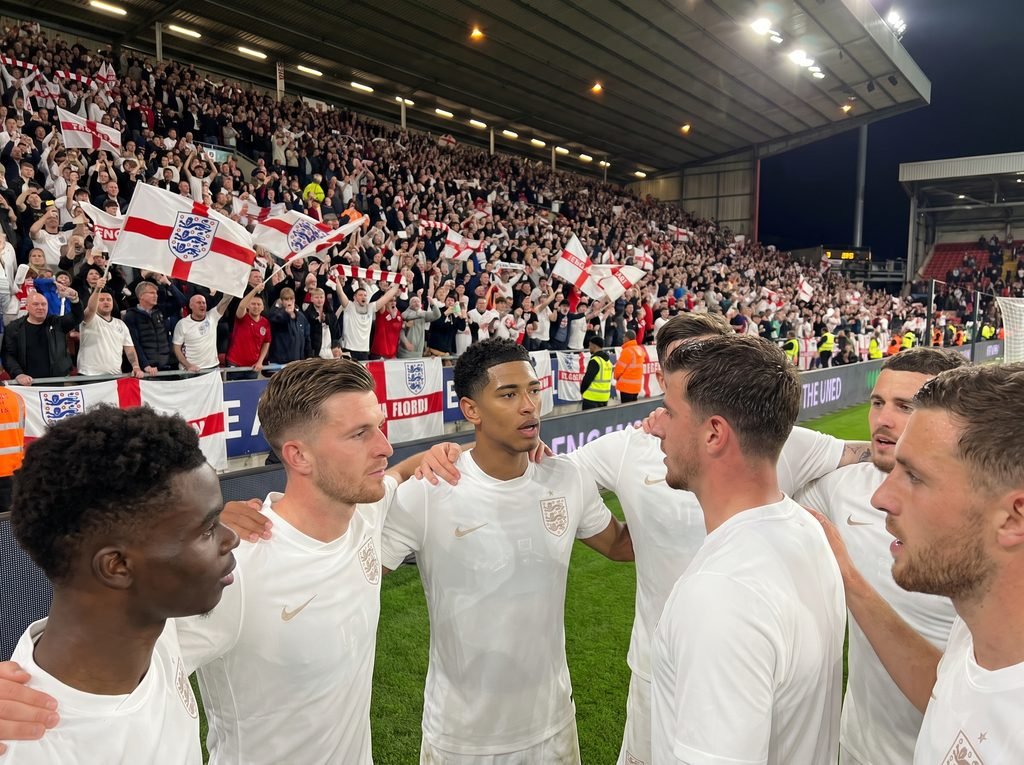
The phrase “Three Lions” is instantly associated with English football. It comes from the royal arms of England and has become one of the most familiar symbols in international sport. The badge appearing on an England shirt represents a national football identity built over more than a century.
What makes the England national football team particularly fascinating is the combination of history and expectation surrounding it. England is widely recognized as one of the traditional powers of world football, yet its major-tournament success has been limited compared with some other elite nations. That contrast creates an unusual atmosphere around every major competition.
England supporters are rarely satisfied simply with qualification. Reaching a World Cup or European Championship is generally considered the minimum expectation. What fans want is progress through the knockout rounds, a place among the world’s best, and ultimately a trophy.
The team’s international reputation also comes from its historic relationship with the development of modern football. England played a major role in formalizing organized football, and the national team has been part of the international game since the 19th century. England Football records the senior men’s side as having played more than 1,100 matches since 1870, with more than 2,400 goals scored across its history.
That remarkable longevity helps explain why almost every era of English football contains famous names, controversial moments, tactical debates, and unforgettable matches.
The Origins of the England National Football Team
The history of the England national side stretches back to the earliest days of international football. England’s first officially recognized international match took place in 1870 against Scotland, while a long-running rivalry with Scotland helped establish international football as an important part of the sporting calendar.
In those early years, the game looked very different from the football seen today. Tactics were less structured, substitutions did not exist in the modern sense, and passing systems were still developing. Even so, international fixtures created a growing sense that football could represent national identity in a powerful way.
England was also central to the formation of international football structures. The Football Association had already been established in 1863, and its rules helped influence how the modern game developed. As football spread across Europe and beyond, England became both an important historical reference point and a team expected to perform at the highest level.
Over time, the England shirt evolved into a national symbol. The famous white home kit became deeply connected with the team’s identity, while tournament shirts from different eras remain popular with collectors and supporters.
England’s official history shows how dramatically the national team developed from those early fixtures into a side that would eventually compete on the global stage at the FIFA World Cup and UEFA European Championship.
The 1966 World Cup: The Greatest Night in England Football History
No discussion of the England national football team can begin without mentioning 1966.
England hosted the FIFA World Cup and entered the tournament carrying significant expectations. The team was managed by Alf Ramsey and captained by Bobby Moore, while players such as Geoff Hurst, Bobby Charlton, Martin Peters, Gordon Banks, and Jack Charlton became central figures in one of the most famous stories in football history.
England opened the tournament with a goalless draw against Uruguay before beating Mexico and France. The knockout stage brought increasingly difficult challenges, including a quarter-final against Argentina and a semi-final against Portugal.
Then came the final at Wembley on 30 July 1966.
England defeated West Germany 4-2 after extra time in a match that remains one of the most iconic finals ever played. Geoff Hurst scored a hat-trick, while Martin Peters also found the net. Hurst’s second goal remains one of the most debated moments in World Cup history, after the ball struck the underside of the crossbar and bounced near the goal line before being awarded.
England Football records the victory as the country’s first major international honour and its only senior men’s World Cup title to date.
For generations of supporters, 1966 has become more than a sporting achievement. It is a cultural memory passed from parents to children. Whenever England reaches another World Cup, comparisons with that historic side inevitably return.
The 1966 triumph also created a unique challenge. Because England has not won another senior men’s World Cup since, every tournament is measured against the standard established on home soil sixty years ago.
England’s Long Search for Another Major Trophy
After 1966, England often remained competitive but struggled to turn strong squads into major tournament victories.
There were promising World Cup campaigns, including a run to the semi-finals in 1990. That team, managed by Bobby Robson, became famous for its courage, attacking quality, and emotional journey. The semi-final against West Germany was decided on penalties, producing another painful chapter in England’s history.
The 1990 campaign also helped shape the public image of English football. Players such as Paul Gascoigne, Gary Lineker, Peter Shilton, and David Platt became international icons.
Six years later came Euro 1996, hosted in England. Once again, the national side reached the semi-finals but fell to Germany on penalties after a tense match at Wembley. Gascoigne’s famous near-miss against Scotland remains one of the tournament’s best-known images.
That tournament produced the phrase “Football’s Coming Home,” taken from the song associated with the competition, and it became deeply connected to England football culture. The optimism of Euro 1996 was eventually replaced by another penalty shootout heartbreak.
England subsequently produced talented generations featuring players such as David Beckham, Steven Gerrard, Frank Lampard, Wayne Rooney, Rio Ferdinand, John Terry, Ashley Cole, and others. Yet the team repeatedly fell short of winning a major senior men’s trophy.
The pattern contributed to a complicated relationship between the team and its supporters. Expectations remained extremely high, but history had created a cycle in which every disappointing exit seemed to reinforce the idea that England could compete but not finish the job.
The Modern Revival of England Football
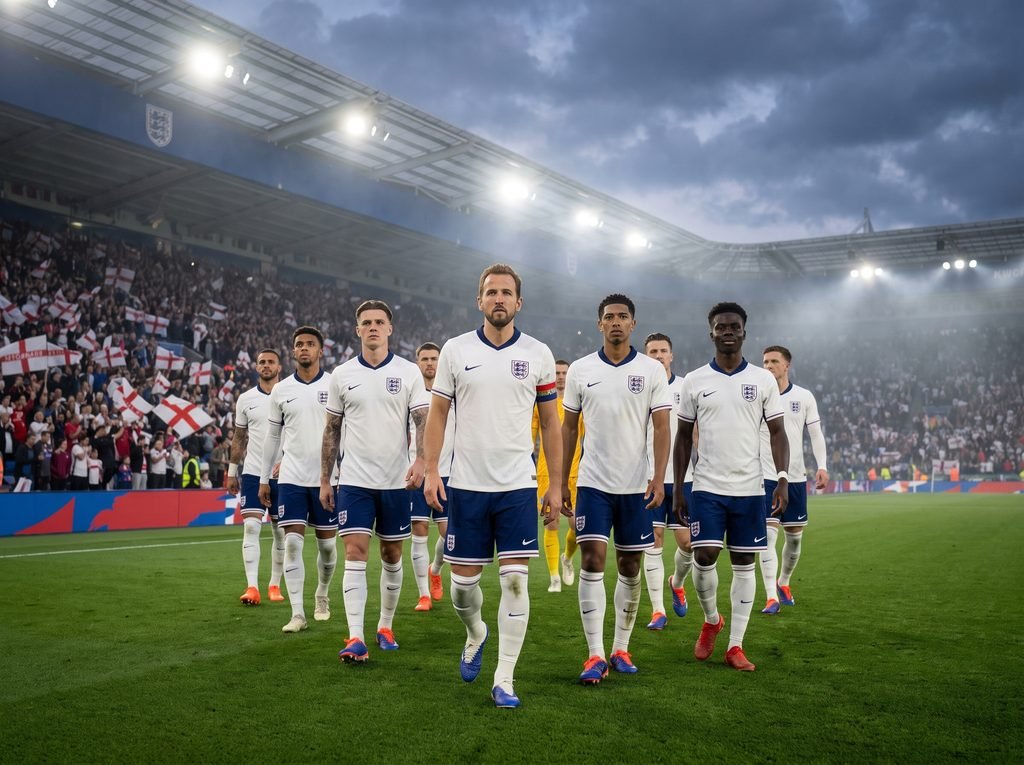
The modern transformation of the England national football team did not happen overnight. Improvements in youth development, coaching structures, tactical education, sports science, analytics, and player development gradually changed the environment around the national side.
England’s youth teams began achieving notable success, producing players who were more comfortable in possession and tactically adaptable than many previous generations.
At senior level, Gareth Southgate’s tenure played a major role in changing the team’s tournament consistency. England reached the 2018 World Cup semi-finals, the Euro 2020 final, the 2022 World Cup quarter-finals, and the Euro 2024 final.
Although trophies did not arrive during that period, England became a regular late-stage contender.
At Euro 2024, England reached the final after defeating the Netherlands 2-1 in the semi-final. The team then lost 2-1 to Spain in the final in Berlin. England Football’s official tournament archive records the entire knockout journey, including the penalty shootout victory over Switzerland and the dramatic win against Slovakia in extra time.
Back-to-back European Championship finals demonstrated that England was no longer simply a team hoping to survive the early stages. It had become one of Europe’s most consistent tournament sides.
Thomas Tuchel and a New Era for England
The appointment of Thomas Tuchel brought a different tactical perspective and a fresh chapter for the national team.
Tuchel is known for his tactical flexibility, detailed preparation, structured pressing, positional organization, and willingness to adjust formations depending on the opponent. His international role presents a different challenge from club management because national teams have far less training time and must maximize a limited number of camps.
England Football announced in February 2026 that Tuchel had extended his contract through UEFA Euro 2028. The federation noted that he had overseen an unbeaten World Cup qualifying campaign in which England scored 20 goals and conceded none.
That qualifying record created a strong platform for the 2026 World Cup.
Tuchel’s first major tournament with England ultimately ended with the team finishing third. England defeated Mexico in the round of 16, Norway in the quarter-final, and then lost to Argentina in the semi-final. They recovered to beat France 6-4 in the bronze medal match.
The result was historically significant. England’s third-place finish was its best World Cup performance since 1966 and its strongest finish at a World Cup held outside England.
What Makes the England Playing Style Different Today?
The England national football team of the modern era is generally more technically sophisticated and tactically flexible than many previous versions.
England can build patiently from the back, press aggressively, attack in transition, or use wide players to stretch defensive lines. The squad’s depth allows different combinations depending on opposition and match situation.
Modern England also benefits from a generation of players accustomed to elite club environments. Many England internationals play regularly in the UEFA Champions League and other high-level competitions, giving them experience against sophisticated tactical systems.
The role of midfield has become especially important. Modern England can use midfielders who are comfortable progressing the ball, defending space, carrying possession, and arriving in attacking positions.
At the same time, the team has significant attacking quality. England’s forward options can combine movement, creativity, pace, physicality, and finishing.
The challenge for any England manager is not simply selecting the best individual players. It is finding the balance that allows those players to function collectively.
Harry Kane and England’s Goal-Scoring Era
Harry Kane has become one of the defining players of modern English football.
His combination of finishing ability, movement, passing, positioning, and leadership has made him one of the most important forwards in the history of the national side.
England’s current player statistics show Kane leading the recent goalscoring figures with 11 goals, ahead of Jude Bellingham with six and Bukayo Saka with five in the tracked period displayed by England Football.
Kane’s role has also evolved. Earlier in his career, he was known primarily as a penalty-box striker. As his game developed, he became increasingly involved in build-up play, dropping deeper to link midfield and attack.
This versatility has been useful for England, particularly against opponents that defend with a deep block.
His leadership has also been important. The 2026 World Cup squad was announced with Kane as captain, reinforcing his central position within the national setup.
Jude Bellingham and the Next Generation of England Stars
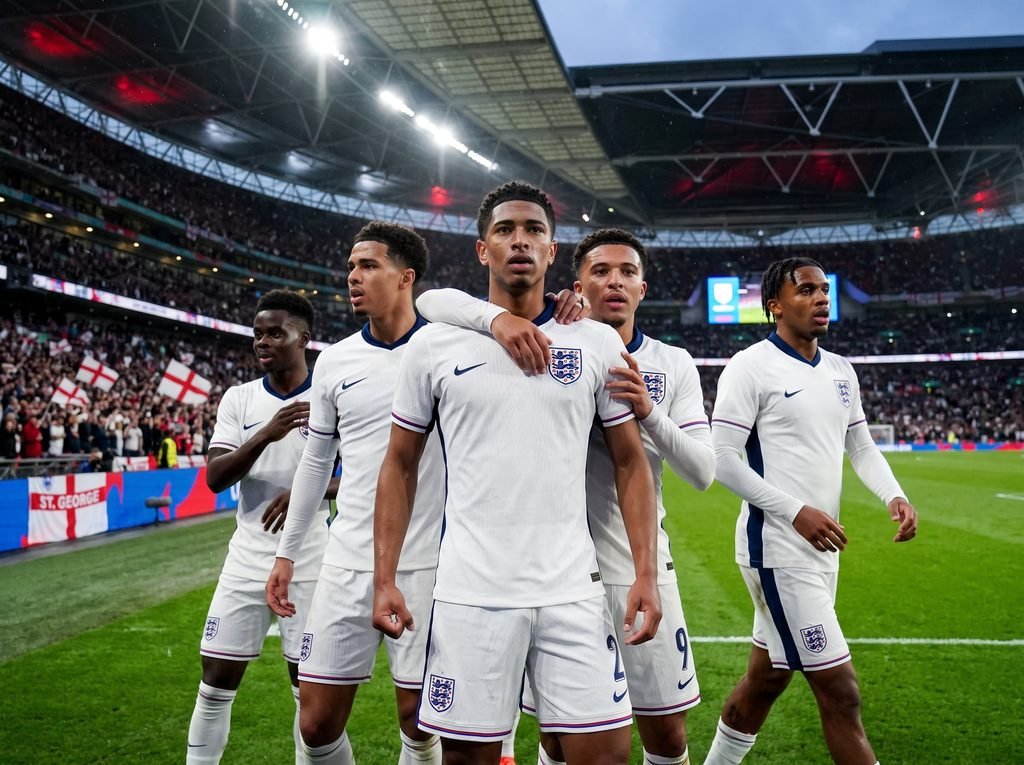
Jude Bellingham represents another defining figure in the current England national football team.
His ability to operate across midfield, carry the ball through pressure, create chances, and contribute goals makes him one of the most tactically valuable players in the squad.
Bellingham’s style gives England the opportunity to combine traditional midfield control with modern attacking movement. He can play deeper when needed but also arrive in dangerous positions near the penalty area.
The next generation extends far beyond one player. England has developed a deep talent pool featuring young attackers, creative midfielders, defenders comfortable in possession, and full-backs capable of contributing to attacks.
Bukayo Saka is another major part of that generation. His direct running, left-footed creativity, work rate, and consistency have established him as one of England’s most important attacking players.
Declan Rice provides another example of the modern England midfielder. Strong defensively while also increasingly influential in possession, Rice can give the team stability while allowing more attacking players greater freedom.
England’s Goalkeeping Tradition
England has produced a long line of high-profile goalkeepers.
Gordon Banks remains one of the most celebrated, while Peter Shilton later became a record-setting figure. More recently, Jordan Pickford has established himself as a key part of England’s tournament teams.
Pickford’s distribution is particularly useful in modern football. Goalkeepers are now expected to contribute to build-up play, not merely stop shots.
England’s squad data lists Pickford among the side’s most frequently involved players in the recent statistical sample, showing his importance within the team’s structure.
Competition for the position remains healthy because England has continued to produce capable goalkeepers. That depth is valuable during long international campaigns.
England’s Defensive Evolution
Defensive football has also changed dramatically.
Previous generations often relied heavily on physical strength and traditional man-marking. Modern England is expected to defend space, press intelligently, control transitions, and begin attacks from deep.
Centre-backs increasingly need composure on the ball as well as traditional defensive qualities. Full-backs are also asked to perform multiple roles depending on the formation.
Players such as John Stones helped demonstrate how defenders could become playmakers, stepping into midfield and helping the team control possession.
The current squad includes defenders with different profiles, allowing the manager to adapt based on whether England wants to dominate possession or defend more aggressively.
England at the FIFA World Cup
The FIFA World Cup remains the most important tournament in English football.
England’s only World Cup title came in 1966, but its later history contains several strong performances.
The 1990 semi-final remains one of the defining campaigns of the late 20th century. England returned to the semi-finals in 2018 before losing to Croatia.
At the 2022 World Cup, England progressed to the quarter-finals. The team defeated Senegal in the round of 16 but lost to France in the quarter-final.
The 2026 tournament produced a historic improvement. England navigated the expanded tournament format and progressed deep into the competition before losing 2-1 to Argentina in the semi-final. The Three Lions responded by defeating France 6-4 in the third-place match.
The campaign included a 3-2 victory over Mexico, a 2-1 extra-time win over Norway, and other important performances that demonstrated England’s ability to survive difficult knockout matches.
Finishing third does not end England’s search for a second world title, but it does provide another important sign that the national team belongs among the world’s strongest sides.
England at the UEFA European Championship
England’s European Championship journey has often been just as dramatic as its World Cup history.
The team reached the final of Euro 2020 after beating Denmark 2-1 in extra time in the semi-final at Wembley. England then lost to Italy on penalties in the final.
At Euro 2024, England again reached the final. After progressing through a tense group stage and knockout matches, the Three Lions eliminated Switzerland on penalties, defeated the Netherlands in the semi-final, and then lost to Spain in Berlin.
Back-to-back European Championship final appearances represented a significant achievement, even without the trophy.
For England supporters, however, those defeats also created another question: can a team that consistently reaches major finals finally complete the final step?
That remains one of the central narratives surrounding the national side.
England’s Famous Rivalries
International football is heavily influenced by rivalry, and England is fortunate to have several.
Scotland is the oldest and most traditional rival. Matches between the two countries have a long historical background and remain highly emotional even when tournament qualification is not at stake.
Germany has developed into another famous rivalry because of repeated World Cup and European Championship encounters. Penalty shootouts and knockout-stage drama have contributed to its importance.
Argentina is associated with several iconic and controversial World Cup meetings, including the famous 1986 quarter-final and the 1998 tournament.
Spain, Italy, France, the Netherlands, and Brazil are also major opponents that regularly test England’s quality.
These fixtures matter because they provide an additional measuring stick. Beating a strong rival in a competitive tournament can change the mood surrounding the entire national team.
Wembley Stadium and the England Supporter Experience
Wembley Stadium is central to the identity of the England national football team.
The modern Wembley offers a huge stage for qualifiers, Nations League matches, friendlies, and important competitive fixtures. It also carries the symbolic weight of being the venue where England won the 1966 World Cup.
Playing at Wembley creates unique pressure. The stadium can provide enormous encouragement when the team is performing well, but expectations can also become intense during difficult matches.
England supporters are known for their songs, flags, shirts, scarves, and emotional investment. Matchdays often become national sporting occasions rather than ordinary fixtures.
That relationship between supporters and team remains one of the most powerful parts of international football.
England’s Upcoming Matches and the Next Competitive Cycle
After the 2026 World Cup, England’s attention turns toward the UEFA Nations League.
As of September 2026, England’s official schedule lists a Nations League Group A3 fixture against Spain at Wembley on 26 September 2026, followed by matches against Czechia and Croatia, with additional group fixtures later in October and November.
These fixtures are important for more than the competition itself. They provide Tuchel with an opportunity to test combinations, introduce emerging players, refine tactical ideas, and begin shaping the squad that will eventually compete at Euro 2028.
The meeting with Spain should attract especially strong attention because Spain has become one of Europe’s most difficult opponents. England’s recent major-tournament history against Spain has already included the Euro 2024 final, making future meetings even more significant.
Why the Nations League Matters to England
Some supporters may view Nations League matches as less important than World Cup or European Championship games, but they serve a valuable purpose.
Competitive international football gives managers fewer opportunities than club coaches have. A national manager cannot work with players every week. Every training camp is short, and each match becomes a chance to improve.
The Nations League creates meaningful fixtures against high-quality opponents instead of relying entirely on friendly games.
For England, that means regular tests of its tactical structure against teams capable of exposing weaknesses.
A strong Nations League campaign can also build confidence and allow the squad to experiment without the immediate pressure of a major tournament knockout game.
The Importance of Youth Development in English Football
One of the biggest reasons for optimism around the England national football team is the quality of player development.
Academies across England have invested heavily in coaching, sports science, nutrition, analysis, psychology, and technical education.
Young players are now introduced to tactical ideas at much earlier ages. Many learn multiple positions and develop better technical control under pressure.
This has changed the type of footballer available to the senior national team.
Instead of relying on a small group of traditional stars, England can increasingly choose from a broad generation of players competing at elite clubs.
That depth creates competition for places and reduces the risk that an injury to one player completely changes the team’s identity.
The Tactical Challenge Facing Thomas Tuchel
Tuchel’s biggest task is not discovering talent. England already has plenty.
The challenge is creating the most effective structure for those players.
Should England use four defenders or three? Should the midfield prioritize control or creativity? Should Bellingham operate higher up the pitch? How much freedom should attacking players receive? When should full-backs push forward?
These decisions can determine whether a group of excellent footballers becomes an excellent team.
International football rewards tactical clarity because there is less time for players to develop automatic patterns.
Tuchel therefore needs a system that is flexible enough to change but simple enough to understand quickly during international camps.
The Biggest Strengths of the England National Football Team
England’s biggest strength is arguably its depth.
In several positions, there is more than one high-level option. That gives the manager flexibility while also increasing competition.
The team’s attacking quality is another major advantage. England can create chances through individual brilliance, quick transitions, wide attacks, combinations around the penalty area, and set pieces.
Midfield quality is also a major asset. Modern English midfielders can combine physical strength with technical ability and tactical intelligence.
Another strength is tournament experience. Many current players have already played in European Championship finals, World Cup knockout matches, and high-pressure club fixtures.
That experience can become decisive during extra time, penalties, and late-game situations.
The Challenges England Still Needs to Solve
Despite recent success, the England national football team continues to face important challenges.
The first is finishing tournaments with trophies. Third place at the 2026 World Cup is a major achievement, but it does not remove the desire for another title.
The second is balancing expectations. England’s talent is so strong that anything less than a deep tournament run can quickly be described as failure by sections of the media and supporters.
The third is managing pressure during knockout matches. Small mistakes become hugely expensive when there are no second chances.
Another challenge is finding the best tactical balance. Too much conservatism can reduce attacking threat, while too much freedom can expose defensive weaknesses.
England must also plan for succession. Some established stars will eventually leave the international stage, and younger players must gradually become leaders.
England’s Most Important Historical Figures
The history of English football includes an enormous list of iconic figures.
Sir Alf Ramsey will forever be connected to the 1966 World Cup. Bobby Moore is remembered as an elegant and inspirational captain. Geoff Hurst’s final hat-trick made him an enduring part of World Cup history.
Bobby Charlton became one of England’s greatest-ever attacking midfielders and played a central role in the 1966 triumph.
Later generations added their own heroes, including Gary Lineker, David Platt, Paul Gascoigne, Alan Shearer, David Beckham, Steven Gerrard, Frank Lampard, Wayne Rooney, Rio Ferdinand, and many others.
Each era contributed something different. Some provided trophies, others produced memorable tournaments, and some became symbols of a footballing culture.
England’s Record and Statistical Legacy
The scale of England’s history can be seen through its statistics.
England Football lists more than 1,100 senior men’s matches since 1870 and over 2,400 goals, while recording the team’s 1966 World Cup victory as its best World Cup finish.
The statistics are also a reminder of how much the national team has changed. More than a thousand matches represent generations of different formations, managers, political eras, stadiums, competitions, and playing styles.
Every current international therefore becomes part of a much larger historical record.
Modern supporters can watch a player make his debut and potentially follow his entire international career, just as previous generations followed the careers of their own heroes.
Why England Continues to Attract Global Attention
The England national football team is not followed only in England.
The Premier League’s global popularity has helped create international interest in English players. Supporters around the world regularly watch England internationals playing for major clubs.
That visibility means England games attract viewers across Europe, Asia, Africa, North America, South America, and beyond.
The team’s famous history also adds another layer of interest. When England plays a major tournament, fans are not just watching the current squad. They are watching the latest chapter of a football story that began more than 150 years ago.
What Can England Achieve Before Euro 2028?
The next major objective is UEFA Euro 2028.
England will enter that tournament with a powerful combination of experience and emerging talent. Players who featured prominently at the 2026 World Cup should still be central figures, while younger players could develop into international regulars.
The tournament will have added significance because it will be hosted in the United Kingdom and Ireland.
England supporters will naturally dream of another home tournament triumph. The memory of 1966 makes that ambition even more powerful.
However, success will depend on more than home advantage. England will have to handle expectations, injuries, tactical challenges, and the pressure of knockout football.
The foundation is already strong, but the final step remains the hardest.
How Fans Can Follow England More Closely
Following the England national football team has never been easier.
Supporters can monitor official fixtures, results, squad announcements, match reports, player profiles, and tournament news through England Football’s official platforms. The federation also provides dedicated information for the senior men’s team, including fixtures and player statistics.
For the most accurate match information, official sources are preferable to relying on social media rumors or unofficial squad lists.
Fans can also follow tournaments through recognized broadcasters, football apps, live score services, and official competition websites.
The best approach is to combine real-time match coverage with deeper reporting that explains tactical changes, player performances, and selection decisions.
The Future of the England National Football Team
The future of the England national side looks promising.
A strong academy system continues to produce talented footballers, the senior squad contains experience at the highest level, and the team has demonstrated that it can compete deep into major tournaments.
The 2026 World Cup added another milestone by securing England’s highest finish since 1966.
But football rarely rewards reputation alone.
England’s next objective is to turn consistent tournament competitiveness into silverware.
That means finding the right balance between experienced leaders and younger talent. It means maintaining physical freshness across international windows. It means developing tactical flexibility without sacrificing clarity.
Most importantly, it means performing at the highest level when a tournament reaches its decisive moments.
Final Thoughts on the England National Football Team
The story of the England national football team is one of football’s most compelling combinations of history, talent, pressure, disappointment, and hope.
England has already achieved something enormous by winning the 1966 World Cup. It has also produced generations of legendary players and repeatedly challenged for major honours.
In recent years, the team has gone through a significant transformation. England reached major tournament finals, became more tactically sophisticated, developed outstanding young talent, and established itself as a consistent contender.
The 2026 World Cup provided another major achievement, with England finishing third after defeating France 6-4 and registering its best World Cup finish since 1966.
Now, under Thomas Tuchel and with another generation of elite players emerging, the focus shifts toward the next challenge.
England’s supporters do not simply want good performances. They want the trophy.
That is what makes every England fixture meaningful. Every pass, goal, save, substitution, and knockout match becomes part of a national football story that has been developing for more than a century.
The journey continues, and the next chapter could be one of the most exciting yet.
Ready to follow the Three Lions through their next chapter? Keep this guide bookmarked, follow the latest England fixtures and squad news, and stay connected with every major development as the road to Euro 2028 unfolds.