If you are wondering what type of plastic for greenhouse growing to choose, start with the frame: greenhouse-grade, UV-stabilised polyethylene film suits most polytunnels and hoop houses, while UV-protected polycarbonate panels suit rigid greenhouses designed for sheet glazing. Polyethylene is often called polythene in the UK. These are two names for the same plastic.
For a flexible cover, 6-mil greenhouse film—about 152 microns—is a useful starting point when comparing products. For rigid panels, choose the thickness and fixing system specified for your greenhouse. A thicker sheet is not automatically a suitable replacement. University guidance identifies polyethylene film as a lightweight, economical covering that works particularly well over curved structures. University of Arkansas greenhouse glazing guidance.
Table of Contents
The right choice depends on your growing season, local weather, budget and willingness to replace the covering. This guide explains how to compare the options without getting lost in technical labels.
What Type of Plastic for Greenhouse Frames Makes Sense?
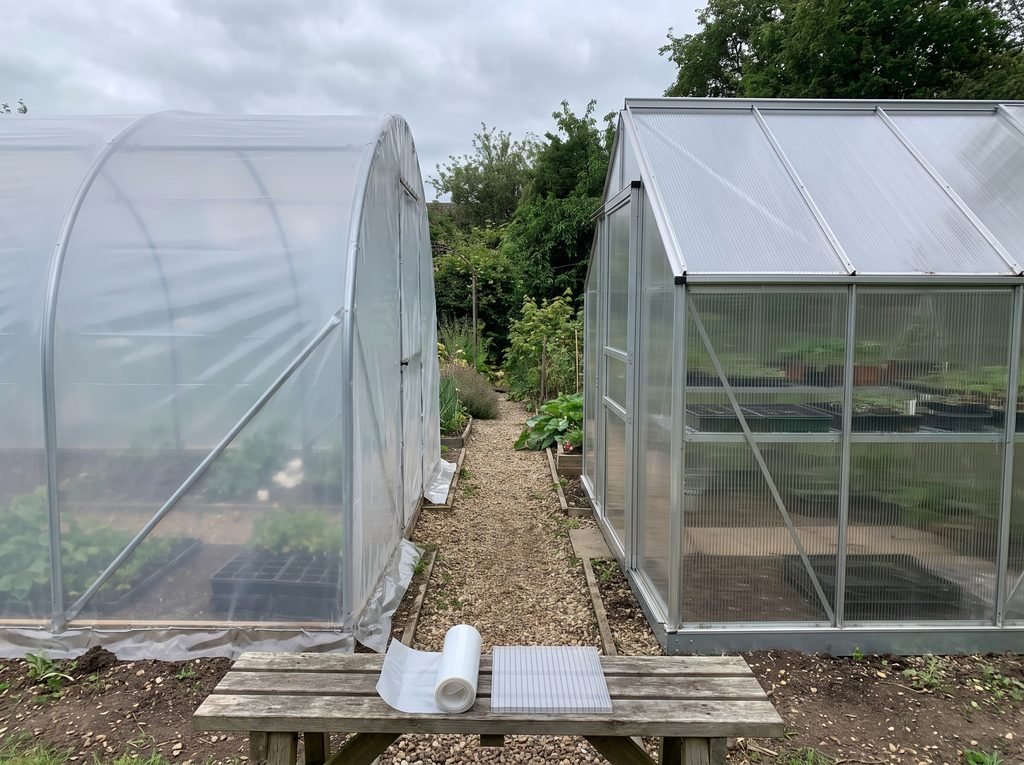
Before comparing prices, decide whether you need a flexible skin or rigid glazing. They perform the same basic job but attach to structures in different ways.
A polytunnel normally needs a continuous film stretched and secured over its frame. A rigid greenhouse generally uses separate panels held within glazing bars, channels or other approved fixings.
| Plastic covering | Where to consider it | Main attraction | Main limitation |
|---|---|---|---|
| Greenhouse-grade polyethylene film | Polytunnels, hoop houses and suitable DIY frames | Lightweight covering for large or curved areas | Needs periodic replacement |
| Reinforced greenhouse film | Structures designed for reinforced covers | Reinforcement can help resist tearing | Light transmission and quality vary |
| Twin-wall or multiwall polycarbonate | Compatible rigid greenhouse frames | Insulating air spaces and impact resistance | Requires suitable supports and fittings |
| Solid or corrugated polycarbonate | Frames designed for these profiles | Rigid covering without a cellular interior | Does not provide the same air-space insulation |
| Other specialist plastic glazing | Manufacturer-specified systems | May meet a particular design requirement | Requires closer checking of specifications |
Treat this as a shortlist, rather than a ranking. A good film on the correct frame can be a better purchase than expensive panels fitted to an unsuitable structure.
If you are replacing an existing cover, find the greenhouse model or original instructions first. Knowing the approved material can save you from buying something that needs extensive alterations.
Greenhouse-Grade Polyethylene Film: A Practical Starting Point
Polyethylene film is worth considering when you want to cover a growing space without buying individual rigid panels. It is supplied in rolls or sheets, making it convenient for tunnels and curved roofs.
The key buying term is greenhouse-grade. Ordinary clear plastic can look similar while having a very different intended use.
Why UV stabilisation matters
Sunlight gradually damages many plastics. UV stabilisers help greenhouse film resist that damage, allowing suitable products to remain outdoors longer than an untreated sheet.
The University of Connecticut recommends greenhouse-grade material over construction-grade plastic and identifies sunlight, heat and installation damage as important causes of film deterioration. UConn’s guide to greenhouse plastic film.
Look for a written specification that names the material, thickness, outdoor application and warranty. “Heavy duty” on its own does not tell you whether a sheet was designed for a greenhouse.
How long should greenhouse film last?
There is no single lifespan for every film. Virginia Cooperative Extension explains that UV-resistant additives can extend polyethylene glazing life to around three or four years or longer. Actual service depends on the product and conditions. Virginia Cooperative Extension’s guide to greenhouse coverings.
Use that as background, not a promise for your purchase. Read whether a warranty covers UV deterioration, manufacturing faults or other failures. Do not assume it includes storm damage, accidental tears or installation errors.
Ask yourself whether replacing the cover will be manageable. A material can be inexpensive to buy but inconvenient if you need paid help every time it is renewed.
Understanding Film Thickness: Microns, Millimetres and Mil
Thickness labels can be confusing because UK and US suppliers often use different units.
A micron is one-thousandth of a millimetre. A US mil is one-thousandth of an inch. It does not mean millimetre.
| Stated thickness | Equivalent thickness |
|---|---|
| 100 microns | 0.10 mm, approximately 3.94 mil |
| 150 microns | 0.15 mm, approximately 5.91 mil |
| 6 mil | 0.1524 mm, or 152.4 microns |
| 180 microns | 0.18 mm, approximately 7.09 mil |
| 200 microns | 0.20 mm, approximately 7.87 mil |
A 6-mil flexible film is therefore much thinner than a 6 mm rigid panel. The similar numbers describe completely different products.
For greenhouse film, around 150–200 microns is a useful comparison range, subject to the frame maker’s requirements. UK listings may also use gauge. Because that label is easy to misread, ask the supplier to confirm the thickness in microns or millimetres.
Thickness should be one part of your decision. Compare UV protection, light transmission, reinforcement and intended service alongside it. If a listing gives only a thickness and a vague durability claim, request more information before ordering.
Polycarbonate Panels for a Rigid Greenhouse
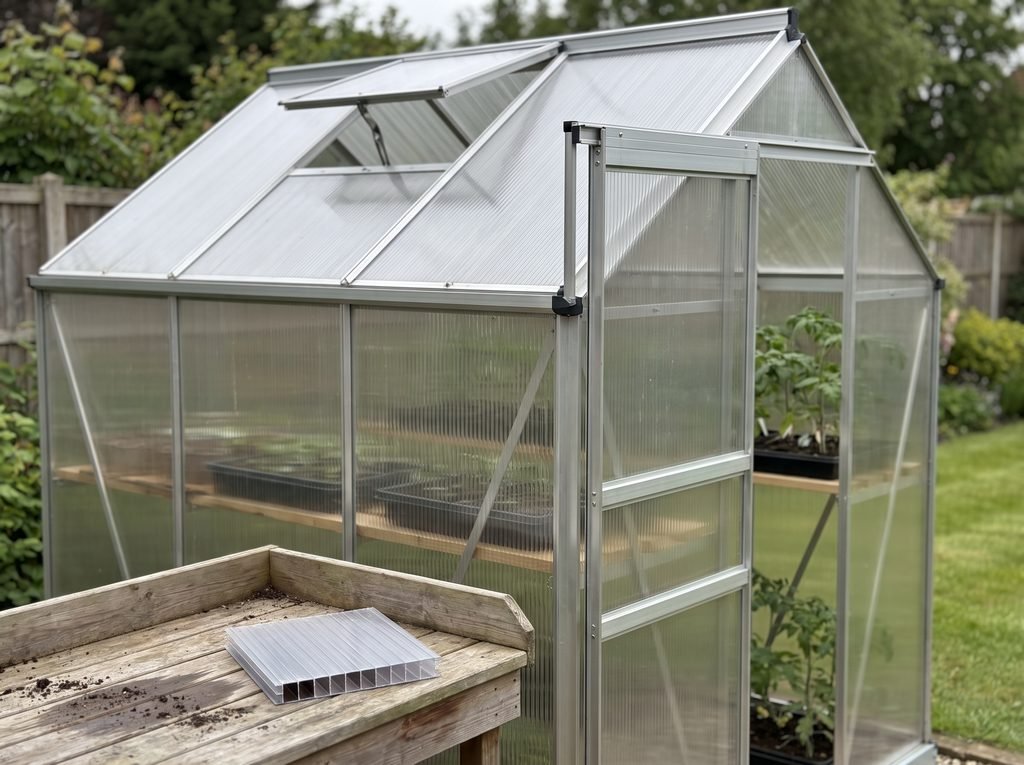
Polycarbonate is a suitable option when you want plastic glazing for a permanent frame. The RHS identifies it as a durable greenhouse material with useful heat retention. RHS advice on choosing a greenhouse.
However, “polycarbonate” describes the material, not the complete performance of a panel.
Twin-wall and multiwall panels
Twin-wall panels have two outer faces connected by ribs, leaving channels inside. Multiwall designs contain additional layers or internal divisions.
These air spaces help reduce heat transfer. Palram’s technical information distinguishes multiwall sheets from single-layer sheets and describes their combination of low weight, impact resistance and insulation. Palram’s multiwall polycarbonate information.
For a beginner, the practical question is whether improved insulation is worth the added purchase and installation cost. Someone using a greenhouse mainly for summer crops may make a different choice from someone planning a heated winter growing space.
Solid and corrugated panels
Solid polycarbonate has no hollow channels. Corrugated sheets have a shaped profile and should be fitted using the supports and fasteners intended for that profile.
Do not assume a panel is suitable because it is transparent and made from polycarbonate. Check that its colour, light transmission and approved application match your project. Some roofing products are designed to reduce incoming light.
Which panel thickness should you buy?
Use the greenhouse manufacturer’s specification as your starting point. If you are designing a new structure, obtain suitable support-spacing and load information for the exact sheet.
Panel thickness alone cannot establish whether a roof will withstand local wind or snow. The supporting frame and attachment system are part of that decision.
For a wider comparison of complete structures, see this guide to polycarbonate greenhouse benefits.
Clear, Diffused or Green Plastic: Which Should You Choose?
For general vegetable growing, start by comparing clear and purpose-made diffusing greenhouse covers. Choose using their published light properties rather than colour alone.
Clear plastic
Clear coverings are useful when maintaining incoming light is a priority. This can matter when you intend to grow during dull weather or shorter days.
Still, a product photo cannot tell you precisely how much usable light reaches plants. Ask for light-transmission data for the exact product, especially when choosing between several films with different additives.
Diffused plastic
Diffusing film scatters incoming light, helping distribute it through the crop. It can be useful for taller plants where upper leaves shade lower growth.
Diffusion and total light transmission describe different things. A sheet can scatter light while still admitting a substantial amount, so “cloudy looking” does not automatically mean poor performance. UConn discusses both diffusion and light transmission as separate greenhouse-film properties. Greenhouse film characteristics explained by UConn.
When comparing products, ask for both figures where available. Avoid choosing purely on claims such as “better growth” without an explanation of the covering’s properties.
Green and reinforced covers
A green cover is not automatically better for plants. Colour is not a substitute for a specification, and visible reinforcing mesh does not establish outdoor lifespan.
For a small replacement cover, check the frame measurements, door position, seams and fastening points as carefully as the material. A close fit matters more than choosing a cover because it resembles the old one in a photograph.
The RHS notes that replacement covers for some mini-greenhouses can be difficult to obtain, making availability worth checking before purchase. RHS guidance on mini-greenhouses.
Useful Film Features and What Their Labels Mean
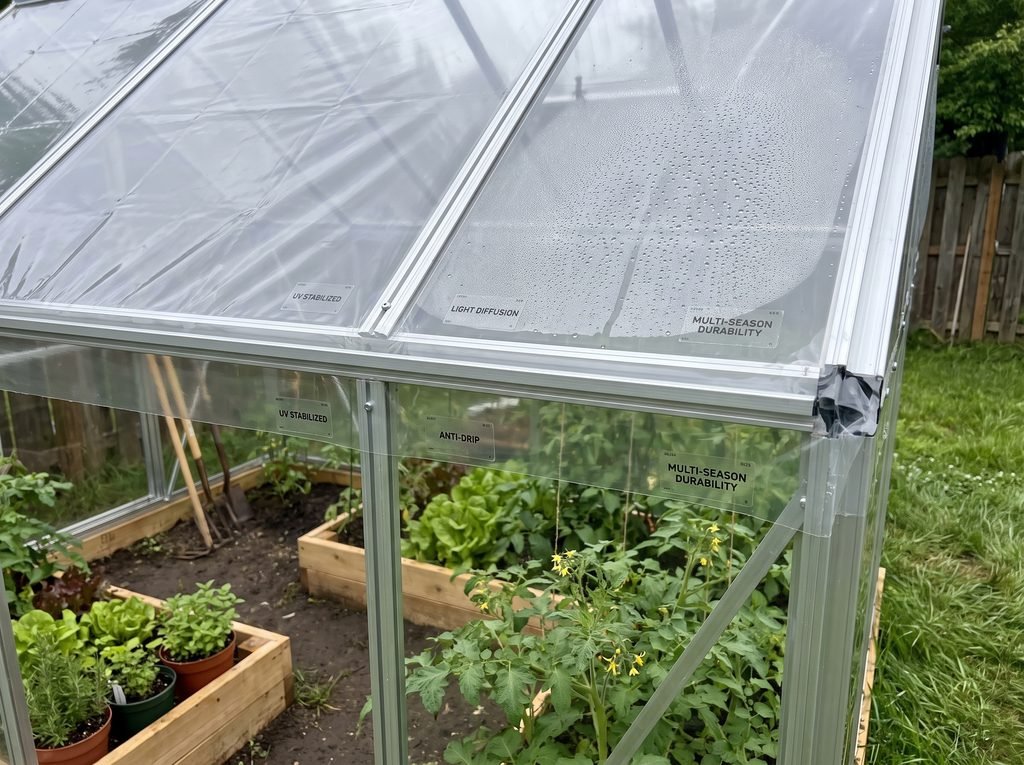
Some greenhouse films include additives for condensation control or heat retention. These can be useful, but you do not need every feature for every growing project.
Anti-drip or anti-condensation treatment
Anti-drip treatment encourages condensation to spread and run along the covering instead of forming larger droplets that fall onto plants.
It does not mean the greenhouse will stay dry or that ventilation becomes unnecessary. Think of it as a way to manage water on the covering, rather than a complete humidity-control system. Virginia Cooperative Extension explains this treatment as a wetting effect on the film surface. Greenhouse covering additives explained.
Ask whether the film has a marked inside face and how long the treatment is expected to remain effective.
Thermal or infrared-retaining film
Some films are designed to reduce the escape of radiant heat. These deserve closer consideration when you plan to heat a greenhouse.
Before paying extra, ask which thermal property the manufacturer means. A product intended to retain heat at night serves a different purpose from one designed to reduce incoming solar heat.
For a seasonal, unheated tunnel, start with the essential specification and assess whether the additional feature solves a problem you actually have.
UV-stabilised and UV-blocking are different descriptions
UV stabilisation concerns the plastic’s resistance to sunlight damage. UV blocking concerns how much ultraviolet radiation passes through it.
Do not treat those terms as interchangeable. If your growing system has particular UV requirements, including managed insect pollination, request the supplier’s transmission information instead of guessing from a durability label.
Choosing Plastic for UK, US and Other Climates
Your local conditions matter more than the country name alone. An exposed coastal garden, a sheltered urban plot and a snowy inland site can need different structures.
UK gardens and allotments
For a seasonal UK polytunnel, compare greenhouse-grade polythene with a clear outdoor specification. Consider whether your main need is raising spring plants, growing summer crops or extending harvests into autumn.
For a rigid garden greenhouse, compare compatible polycarbonate options alongside the available ventilation. The RHS recommends a sunny position with shelter from cold winds and highlights the importance of roof vents. RHS greenhouse selection advice.
Do not solve an exposed-site problem by changing the cover alone. Ask the structure supplier whether the frame, anchoring and covering system suit the location.
US gardens
US climate differences make a single nationwide recommendation unhelpful. A northern gardener planning winter use should ask different questions from someone growing through mild winters and very hot summers.
Use local weather experience to prepare your shortlist: Is snow loading a concern? Does hail occur? Will summer heat be the main limitation? Are you leaving the cover installed all year?
Bring those answers to the supplier. They provide a better basis for advice than asking which plastic is “strongest” without describing the project.
Other countries
Apply the same approach elsewhere. Explain your growing season, sun exposure, wind and likely temperature extremes.
Where imported products use unfamiliar units, convert the thickness before comparing them. Also check that any warranty applies in your country and to your intended use.
Will Plastic Keep a Greenhouse Warm Through Winter?
A plastic cover provides protection, but it does not guarantee frost-free conditions. The RHS advises that tender plants may need additional protection or heating in an unheated greenhouse. RHS advice on growing greenhouse vegetables.
Choose the plants and required minimum temperature before deciding how much insulation you need.
Single film versus an inflated double layer
A double-film system uses two coverings with an air space maintained by a blower. That space improves insulation compared with a single layer, although adding a second covering also affects light transmission.
This is an established greenhouse system, rather than simply draping one sheet over another. The University of Arkansas explains the blower-supported air space used in double polyethylene glazing. Single- and double-layer greenhouse glazing.
For a small beginner project, ask whether the frame is designed for it and whether the equipment and running requirements are justified.
Bubble wrap as extra insulation
Horticultural bubble wrap can serve as an internal insulating layer. It should not be treated as a direct replacement for a properly specified external cover.
The RHS discusses bubble wrap as a greenhouse insulation option, while noting the importance of balancing insulation with plants’ light needs. RHS advice on efficient greenhouse heating.
If winter protection is your priority, consider whether insulating or heating a smaller growing section would meet your needs.
Ventilation Still Matters With Every Plastic Cover
A well-covered greenhouse can overheat. Choosing an insulating material does not remove the need to release excess warmth.
The RHS recommends ventilation and shading to manage greenhouse heat from spring into autumn. Doors, roof vents and side vents can all contribute to airflow. RHS guidance on greenhouse ventilation and shading.
Before ordering a replacement covering, check how the finished greenhouse will open. Will vents still move freely? Does the cover include the correct door openings? Can you access them easily each day?
Use a maximum–minimum thermometer to learn how your greenhouse behaves. That information is more useful than assuming the temperature will be suitable because the covering was sold for gardening.
For a hypothetical example, a gardener raising a few trays in a small covered rack may benefit more from easy ventilation and secure anchoring than from an expensive thermal film.
Measuring and Fitting Your Greenhouse Plastic
Accurate measurements prevent avoidable waste. Do not order a covering from the floor dimensions alone.
Measuring a film cover
For a curved tunnel, measure the actual distance over the frame. Follow the supplier’s method for adding material needed at the sides, ends and attachment points.
Before ordering, confirm whether a roll’s stated width is its fully opened width or a folded measurement. Also establish whether the end walls and doors need separate pieces.
Inspect the frame before installation. Deal with rough contact points and use protective materials approved for the film and frame combination.
Plan the work around suitable weather and available help. A large sheet is difficult to control in wind, so check the installation instructions before opening the packaging.
Fitting polycarbonate panels
Follow the instructions for the exact panel system. Palram’s greenhouse installation guide specifies outward-facing UV protection where applicable, channel alignment for drainage, suitable end treatments and allowance for thermal movement. It also warns against overtightening fixings. Palram’s greenhouse polycarbonate installation instructions.
Do not borrow screw spacing or expansion gaps from an unrelated panel. Keep identifying labels in place long enough to confirm orientation, then remove temporary protective film as instructed.
If replacing glass, ask whether approved conversion fittings are available. Matching the pane dimensions is only part of making the replacement suitable.
For the alternative material, this greenhouse glass guide covers the main glass options.
Compare the Complete Cost Before Buying
Compare installed systems, rather than the price of a bare sheet.
For film, include attachment materials, delivery and any help needed to fit it. For panels, include joining profiles, seals, fixings, cutting and any necessary frame changes.
Then consider future replacement. Ask whether you can buy one panel or one fitted cover separately, and whether the supplier identifies replacements by model.
A useful purchasing method is to request two written quotations using the same greenhouse dimensions and intended growing season. Ask each supplier to list what is included. This makes differences easier to spot.
For a broader project budget, see how much greenhouses cost. Obtain a current quotation for your chosen covering before committing.
Looking After the Cover You Choose
Clean glazing helps preserve incoming light. The RHS recommends greenhouse cleaning as part of maintaining useful growing conditions and identifying repair needs. RHS greenhouse cleaning advice.
Use a cleaning method approved by the covering manufacturer. Do not assume a household solvent, abrasive sponge or pressure washer is suitable.
Make inspection part of your routine. Look for loosening fittings, damaged seams, tears and obstructed drainage. Keep the product details and warranty somewhere accessible so you can order compatible repairs.
Before disposal, ask local waste services or an agricultural-plastics collector whether they accept that material. Describe whether it is film, reinforced film or rigid polycarbonate, and whether it is clean. Do not assume all greenhouse plastics belong in household recycling.
Frequently Asked Questions
Can I use ordinary clear plastic temporarily?
It may serve as an emergency cover if it can be secured appropriately, but appearance alone does not establish outdoor durability. For planned use, buy material with a greenhouse specification and a stated service expectation.
Can I replace greenhouse glass with polycarbonate?
Sometimes. Confirm the correct panel thickness, dimensions and retention system with the greenhouse supplier. Do not assume the original glass clips will hold a different material correctly.
Is reinforced film always better than plain film?
No. Compare the complete specification, including light transmission, outdoor durability and attachment requirements. Reinforcement is one feature, rather than proof that a cover is best for your greenhouse.
What should I ask the supplier before ordering?
Provide the frame model, dimensions, location and planned growing season. Ask for the recommended material, thickness, light properties, fixing instructions and warranty terms. Request clarification on anything missing from the listing.
Conclusion: Choose the Cover That Fits Your Growing Plans
For most beginners, the decision starts with greenhouse-grade polyethylene film for a tunnel or hoop frame, or UV-protected polycarbonate for a compatible rigid greenhouse.
After that, compare the details that affect your project: thickness, light transmission, insulation, attachment requirements and replacement availability. Plan ventilation at the same time.
Before buying, measure your frame and write down what you want to grow and when. Send that information to the supplier and ask them to confirm a suitable covering and fitting system. A clear specification gives you a much stronger starting point than choosing by price or thickness alone.