Planning a trip can become surprisingly complicated when a journey involves more than one form of transportation. You may know where you want to go, but deciding how to get there can involve checking airline websites, railway schedules, bus operators, ferry companies, airport connections, driving routes, and local transfers separately. That is where Rome2Rio becomes useful. It is a global travel search engine designed to help travelers discover different ways to move from one place to another and compare those options in one search. According to current support information, the platform provides estimated prices, journey durations, and booking information from more than 5,000 companies across 160+ countries.
Table of Contents
Instead of forcing travelers to search each transportation provider individually, Rome2Rio brings multiple modes of transport into one planning experience. A search can include flights, trains, buses, ferries, driving, walking, bike-share options, and combinations of several transport types. The official website describes the service as a way to search thousands of multimodal routes between cities, towns, landmarks, attractions, and addresses around the world.
For travelers, the biggest advantage is not simply finding a route. It is understanding the choices available. Sometimes flying is the obvious option. In other cases, a train is faster once airport transfers are considered, while a bus may cost considerably less. A ferry may be necessary for an island destination, and a journey that initially looks complicated can become easy once the different legs are displayed together.
This comprehensive guide explains what rome2rio is, how it works, how to use it effectively, what its prices mean, how booking works, what its Trip Planner offers, where its strengths and limitations are, and how travelers can use the platform as part of a smarter trip-planning strategy.
What Is Rome2Rio and Why Do Travelers Use It?
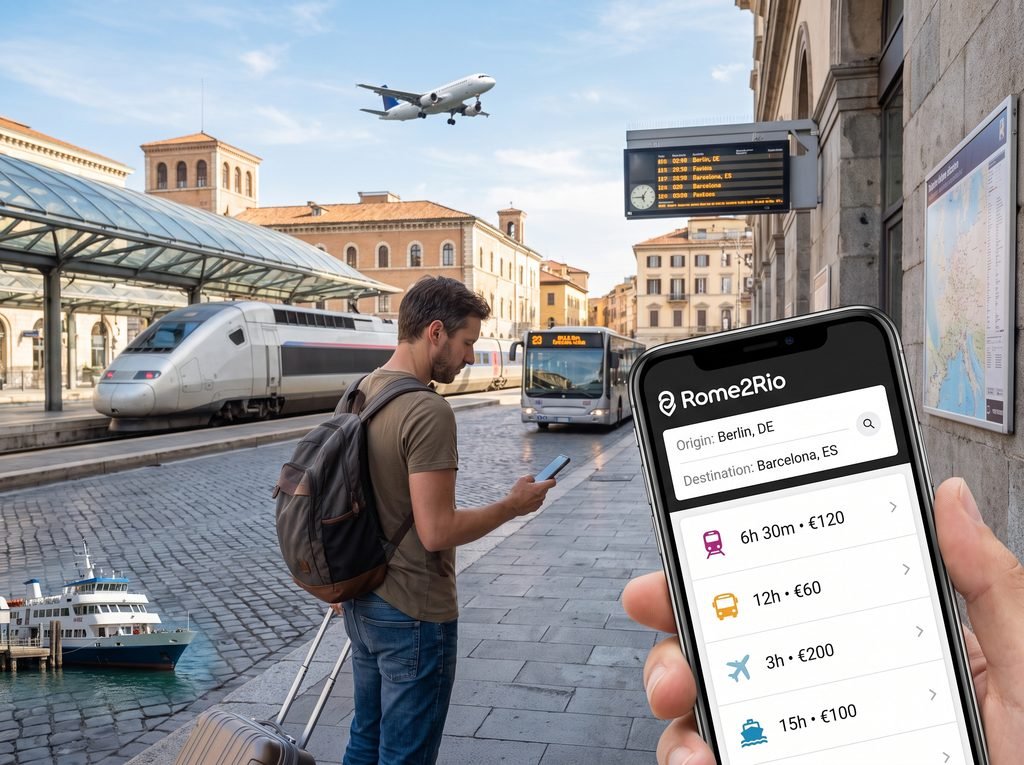
At its core, rome2rio is a transportation discovery and comparison platform. Its main purpose is to answer a simple question that often becomes difficult in practice: how do I get from point A to point B?
The service was created to make transportation information easier to discover. Their official history explains that the company was founded by two engineers who struggled to find accurate travel information and wanted to connect transportation options online. The first version of the platform was launched in 2011, and the company is now based in Melbourne, Australia. became part of the Omio Group in 2019.
The idea behind Rome2Rio is especially valuable for journeys where there is no single obvious transportation provider. Consider a trip from a small village to an international airport, from one European city to another, or from a mainland city to an island. Such journeys may require a local bus, a train, a ferry, and another bus. Searching each part separately takes time and increases the chance of overlooking a better combination.
By putting transportation possibilities into a single search experience, rome2rio helps users think about the journey as a whole rather than focusing on one vehicle at a time. The platform can accept cities, towns, villages, specific addresses, landmarks, stations, airports, and airport codes as search locations.
This makes the service useful for both experienced travelers and people who are unfamiliar with a destination’s transportation network. A frequent traveler might use it to quickly compare options, while a first-time visitor can use it to understand how different parts of the transport system connect.
How Does Work?
Using is straightforward. You enter your departure point and destination, then review the transportation options returned by the service. According to its official guidance, each result can show the transport type, total journey duration, and an estimated price. Selecting a transport option leads to a more detailed schedule view.
The important concept is that Rome2Rio is designed around multimodal transportation. That means a journey can contain one mode or several modes. A route might be a direct train, but it could also be a train followed by a bus, or a flight followed by ground transportation.
This is useful because the cheapest or fastest way between two places is not always the most obvious one. Travelers frequently assume that two cities must be connected by a direct flight, for example, when a high-speed train may provide a more convenient alternative. In another situation, a low-cost airline may appear inexpensive until airport transportation and additional travel time are considered.
Rome2rio brings these alternatives into a comparable format so the traveler can decide which factors matter most. Some people prioritize price. Others prefer fewer changes, shorter travel time, easier transfers, or a particular type of transportation.
The platform also works at a detailed geographic level. The official service says travelers can search from exact addresses and landmarks rather than being limited to major city names. This can be particularly helpful when the real problem is not getting between two cities but reaching a hotel, station, attraction, or airport from a less central location.
What Transportation Options Can You Find?
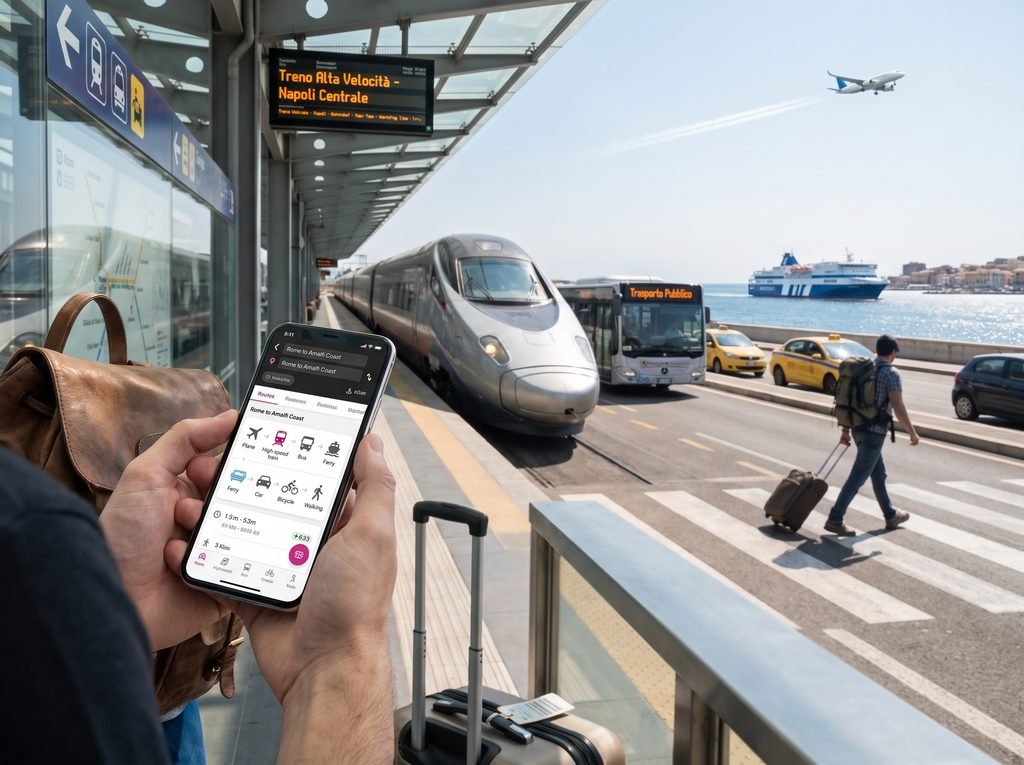
One of the biggest reasons Rome2Rio attracts travelers is its broad transportation coverage. The service combines multiple transport modes instead of treating them as separate planning problems.
Flights and Air Travel
Flights are an important part of international and long-distance travel, and can help users discover air travel options alongside other modes. says its flight coverage is global and enables users to connect with flight-ticketing options around the world.
The value here is comparison. A flight may be the fastest option over a long distance, but that does not necessarily mean it is the most convenient overall journey. A traveler can compare air travel with trains, buses, driving, or combinations where appropriate.
For instance, an airport may be located far outside a city center. A nominally short flight can therefore involve a lengthy airport transfer before and after the flight. Seeing the whole journey in context can make it easier to judge the practical difference between flying and another option.
Trains
Train travel is another major component of rome2rio. Rail networks are especially important in Europe and parts of Asia, where intercity and high-speed trains can compete directly with flights for many journeys.
The homepage currently displays extensive train-network data, listing hundreds of thousands of train lines and thousands of train operators.
For travelers, this type of coverage matters because train journeys can be easier to integrate with city-center travel. Instead of traveling to a distant airport, passengers may be able to reach a central station with local transit.
Buses
Buses play an important role in destinations where rail coverage is limited or where buses provide cheaper connections. includes bus routes from a large number of operators, and its homepage currently lists a very large global network of bus routes and operators.
Bus connections can also complete multimodal routes. A train may take you close to a destination while a regional bus completes the final part of the journey.
Ferries
For coastal destinations, islands, and places divided by waterways, ferries are essential. A conventional flight-and-train search would not necessarily show the most practical route, but Rome2Rio includes ferry connections and can display journeys that combine ferries with land transportation.
This is one of the areas where multimodal planning becomes particularly useful. A traveler may need to reach a ferry terminal by bus or train and then continue by another service after crossing the water. Looking at the route as one journey helps reduce the complexity.
Driving and Car Travel
Driving can sometimes be the best option for families, groups, or travelers visiting areas with limited public transportation. can present driving options and estimated fuel costs. The company explains that its drive estimates use the estimated fuel cost for a standard sedan and exclude tolls and the cost of renting or owning the vehicle.
That distinction matters. A displayed driving estimate should not automatically be treated as the total cost of a road trip. Travelers may also need to consider tolls, parking, rental charges, insurance, fuel price changes, and other vehicle-related expenses.
Walking, Local Transit, and Other Connections
The official website also promotes bike-share, driving, and walking directions as part of its broader travel-planning experience. These options can help fill the gaps between major transport hubs and final destinations.
A journey is rarely just a plane, train, or bus. Often, the first and last parts are local. This is why looking at the complete route can be much more informative than searching only for a long-distance ticket.
Why Is Useful for Complex Journeys
One of the strongest use cases for is complex travel. A direct journey between two major cities can usually be found with a traditional booking website, but reaching a smaller destination can require substantial research.
Imagine traveling from a major international airport to a remote coastal village. You might need to take an airport train, switch to a regional railway, transfer to a bus, walk to a ferry terminal, and then take another local connection. Searching for every step independently is possible, but it is time-consuming.
Rome2rio is useful because it begins with the end-to-end journey. Instead of asking only which train leaves from one station, you can ask how to reach the final destination from your actual starting point.
That broader approach can reveal routes that may otherwise be missed. It also gives travelers a sense of how long the complete journey could take rather than looking at the duration of individual segments without context.
How to Use Step by Step
The easiest way to get value from Rome2Rio is to use it as a discovery and comparison tool rather than immediately selecting the first result.
Start With Your Exact Starting Point
Go to the website and enter where you are starting. This does not necessarily have to be a city. The platform supports addresses, landmarks, stations, airports, towns, villages, and airport codes.
Using an exact location can improve the usefulness of the results because transportation choices depend heavily on where your journey actually begins.
For example, “London” is broad. Your real starting point might be a hotel near a specific underground station or an address on the outskirts of the city. Entering a more precise location can make the resulting route easier to follow.
Enter the Final Destination
Next, enter the destination. Again, using an exact address or landmark can be more useful than relying only on the destination city’s name.
This is especially important when the destination is large. Airports, train stations, convention centers, universities, resorts, and major attractions may be far from a city’s main transportation hub.
Compare the Main Options
After searching, review the available travel methods. presents the available transport options with estimated journey times and prices.
Do not automatically choose the option that appears first. Think about what matters for your trip.
A journey that is slightly more expensive might save several hours. A route with fewer transfers could be much less stressful. A cheaper option could make sense for budget travel if you are not under time pressure.
Open the Schedule Details
Once you choose a transportation type, you can move to the schedule information and examine available services. official instructions explain that selecting an option takes users to the schedule page.
This is the stage where travelers should slow down and check the details carefully. Look at departure times, arrival times, transfer points, and the operator involved.
Check the Booking Provider
When tickets are available through Rome2Rio, the platform can connect users to an external booking partner. explicitly states that it does not directly sell tickets; instead, it connects travelers with trusted booking partners where tickets can be purchased.
This distinction is important because the final booking relationship is generally with the partner, not with itself.
Does Sell Tickets Directly?
This is one of the most important points to understand before booking. is primarily a travel-search and planning platform, and its official support documentation says the company does not directly sell tickets. Instead, it connects users to booking partners.
When ticketing is available, travelers select a journey and are transferred to the relevant booking provider to complete the transaction.
currently identifies several booking relationships, including Omio, FlixBus, 12Go, and GoToGate for different categories and regions. The company’s support information says Omio provides bus and train tickets in Europe and North America, while FlixBus and 12Go add further bus and train options across multiple regions. For flights, says it partners with GoToGate.
This model can be helpful because the traveler can discover a route through and then move directly toward booking. However, it is essential to know which company is actually handling the purchase.
If you need to cancel, amend, or request a refund, says those requests must be handled by the ticketing provider shown in the booking confirmation because does not have access to those bookings or payments.
Are Rome2Rio Prices Accurate?

Price accuracy is an important question whenever a travel comparison platform displays fares. The correct way to think about rome2rio pricing is as useful travel information that should be checked against the final booking details.
explains that prices can change because of availability and seasonality. When it cannot provide an exact price, it may display a price range instead. The company says its transportation pricing is supported by data from ticketing partners, while some estimates are calculated using historical or comparable information when exact data is unavailable.
This means travelers should not treat every displayed number as a guaranteed final fare.
For driving, the company estimates fuel costs using a standard sedan and does not include tolls or rental and ownership costs. Taxi prices are estimated using local taxi data when available.
The practical lesson is simple: use Rome2Rio to compare the economic picture of each travel option, then verify the final price and conditions before purchasing.
A ticket that appears to cost less may come with restrictions, while a slightly more expensive fare may offer better flexibility. Travelers should also account for luggage, seat selection, transfers, local transportation, and other charges that may not be obvious from an initial headline price.
Trip Planner: Planning Multi-Stop Trips
Another useful feature is the rome2rio Trip Planner. According to current support documentation, the Trip Planner allows users to save a trip and create an itinerary containing multiple locations. An account can be used to save an entire journey and access it across devices. At present, the company says this feature is available on desktop and mobile web browsers and is not yet available inside the smartphone apps.
This can be useful for travelers taking longer trips rather than moving between only two places.
Suppose your itinerary includes three countries or several cities. Instead of repeatedly performing separate searches and trying to remember the best routes, you can organize the journey around multiple locations.
The ability to reorder saved stops can also help when the route changes during planning. Rather than starting again from the beginning, you can adjust the itinerary and examine the transportation connections between each location.
For travelers who like to plan in stages, this can make rome2rio more than a simple route finder. It becomes part of the wider itinerary-building process.
Using Rome2Rio for Budget Travel
Budget travelers can benefit substantially from comparison tools because transportation costs vary widely depending on the route and mode.
A traveler who searches only for flights might never consider an overnight bus. Someone focused exclusively on trains might overlook a cheaper coach. Another traveler might discover that a combined train-and-bus trip costs less than flying after airport transfers are included.
makes these options easier to compare. That does not mean the cheapest listed route is automatically the best route. A low fare might involve several transfers, long waiting periods, or inconvenient departure times.
Smart budget travel means comparing total value rather than only the initial ticket price.
A route costing a little more may save a full day. For longer trips, that time can have a real value because it gives you more time at the destination. In the same way, a direct service can sometimes be worth paying extra for when traveling with young children, heavy luggage, or limited mobility.
Use Rome2Rio to discover the range of options, then judge each one according to your own priorities.
Using Rome2Rio for Family Travel
Family travel often requires a different approach to transportation planning. A route that looks efficient for one person may be difficult with children, luggage, strollers, or multiple travelers.
Rome2rio can help families compare direct and multi-stage routes before committing to a particular service.
Suppose a family can choose between a slightly cheaper bus journey with two transfers and a more expensive train that travels directly to the destination. The second option may be more practical even if its price is higher.
Families should also check transfer times carefully. A connection that is comfortable for an experienced solo traveler may be too tight for a group with children or significant luggage.
The platform should therefore be viewed as a discovery tool rather than the final authority on what is easiest for every traveler. Travelers should verify the operator’s rules, especially when luggage, child tickets, accessibility, or special equipment is involved.
Using Rome2Rio for International Travel
International travel becomes more complex because transportation systems differ from one country to another. Language, payment methods, booking rules, ticket formats, and regional transport networks can all vary.
This is another area where rome2rio can provide useful context. Rather than requiring users to know the correct local operator in advance, the platform starts with the origin and destination.
The company’s global search capability currently covers more than 5,000 companies across more than 160 countries according to its help documentation.
That broad reach can make it easier for travelers to understand a destination before arriving.
For example, someone planning a trip to a region with unfamiliar train or bus systems may use to see whether public transport, private buses, ferries, or other connections are available.
Once the route is identified, travelers can then investigate the relevant local operator and booking requirements in more detail.
Using for Road Trips
Road trips require different calculations from public transportation. Travelers need to consider fuel, tolls, parking, rental expenses, driving time, and road conditions.
Rome2Rio can provide a useful starting point by displaying driving options and estimated fuel costs. However, as the company itself explains, its standard driving estimate excludes tolls and the costs associated with renting or owning the vehicle.
That makes the driving figure useful as a comparison rather than a complete road-trip budget.
A traveler planning a rental-car holiday should add the daily vehicle rental rate, insurance, deposits where applicable, fuel, tolls, parking, and any cross-border charges.
Driving can still be one of the best choices for destinations that are poorly connected by public transportation or where several travelers are sharing the cost.
Rome2Rio for Airport Transfers
Airport transfers are an underrated part of travel planning. People often compare a flight’s published duration without considering the time required to reach the airport and then travel from the destination airport into the city.
can help illustrate that complete process by showing connections between addresses, airports, stations, and destinations.
This matters because a flight that appears significantly faster on paper may not produce the shortest real-world journey.
Suppose a train leaves from the center of a city and arrives directly at the center of another city, while a flight requires a long airport transfer at both ends. The total door-to-door time may be much closer than the flight duration suggests.
Thinking in terms of door-to-door travel is one of the most practical ways to use .
How Rome2Rio Helps When You Do Not Know Local Transportation
Travelers often arrive at a destination without understanding how its transport network works. They may not know which station matters, whether buses run frequently, whether a ferry is required, or how far a local airport sits from the city center.
Rome2rio can provide a useful starting map of the transportation possibilities.
Instead of searching random questions such as “bus from airport to city,” you can start with the complete journey. That can reveal the relevant transport modes and connection points.
This reduces the research burden and gives the traveler a clearer framework for additional investigation.
Is Easy to Use on Mobile Devices?
The official website says the service is available on any browser and any device, while also promoting dedicated smartphone applications.
Mobile access is particularly helpful when traveling because transportation decisions often happen while people are already moving.
A traveler may land at an airport and suddenly need to determine the best way to reach a hotel. Another person might miss a connection and need to compare alternative routes.
Having a travel search platform available on a phone can reduce the need to visit several transportation websites.
However, travelers should remember that internet access may be unreliable in some places. It is sensible to save important details, confirmations, addresses, and operator information before traveling through areas with limited connectivity.
Rome2Rio and Current Travel Technology
Travel planning has increasingly moved toward more integrated and conversational experiences, and rome2rio is continuing to expand in this direction.
In August 2026, announced a new connector for Claude designed to bring its multimodal travel-planning experience into an AI conversation, allowing users to explore routes, compare transportation options, check schedules, and follow booking links.
This development reflects a broader trend in travel technology: people increasingly want to describe their trip naturally and receive transportation choices without manually searching multiple systems.
The underlying value remains the same. The technology is changing, but travelers still need reliable information about routes, schedules, prices, transfers, and booking options.
What Makes Different From Traditional Booking Sites?
Traditional online travel agencies often focus on a particular type of transaction. One site may specialize in flights, another in hotels, another in trains, and another in rental cars.
approaches the problem from a different direction: it starts with the journey itself.
That means the user can ask a broader question before deciding which mode of transportation to use.
This can be a major advantage during the early planning stage. Instead of knowing the answer before searching, you can use the platform to discover the answer.
It is the difference between saying, “I need a train ticket from A to B” and asking, “What is the best way to get from A to B?”
The second question is often more useful when you are unfamiliar with the route.
The Limitations You Should Know Before Using
Although Rome2Rio is useful, travelers should not assume that it replaces every transportation provider or every travel-planning resource.
First, prices and schedules can change. itself explains that price estimates may vary based on availability and seasonality, and that an exact figure may not always be available until a specific booking is made.
Second, not every route necessarily has direct ticketing. may show journey information even when it cannot provide a booking link for a particular option.
Third, the final booking may take place with an external partner. This means the traveler should carefully review the external provider’s cancellation, refund, luggage, and ticket conditions.
Fourth, estimated road and taxi costs should be treated as estimates. Real-world costs can differ because of tolls, local pricing, traffic, fuel prices, and other factors.
Finally, travel conditions can change after a route is displayed. Strikes, weather, maintenance, service disruptions, and special events may affect actual journeys.
For these reasons, rome2rio is best used as a highly useful planning layer, followed by confirmation with the relevant transport operator when the trip is important or time-sensitive.
How to Get Better Results From Rome2Rio
There are several simple habits that can make Rome2Rio more valuable.
Start with precise locations instead of broad city names. This can improve the usefulness of local connections and make the estimated journey more relevant.
Next, compare multiple options rather than focusing on the cheapest result. Pay attention to journey time, transfers, departure schedules, and arrival convenience.
Always examine the route details before booking. A route can appear attractive in a summary but become less appealing when you notice multiple transfers or a long waiting period.
Check the final price with the booking partner before completing the purchase. Because fares can change, the amount displayed during discovery may not always be the final amount.
Finally, use the platform as part of a broader planning process. Once you identify a promising route, verify key details with the transport provider, particularly for critical connections.
Rome2Rio vs Searching Every Operator Separately
Searching individual operators can sometimes produce highly detailed information, but the process can become inefficient when a trip involves several modes.
Imagine a trip requiring a local bus, regional train, ferry, and another bus. You would need to identify each provider, understand where one service connects with another, and calculate the total time and cost.
can reduce that initial research workload by presenting the route as one end-to-end journey.
The goal is not necessarily to replace every operator’s website. Instead, it can help travelers identify which providers and transportation types deserve closer attention.
This is especially useful during the discovery phase when the traveler does not yet know which route makes the most sense.
How Travelers Can Compare Price, Speed, and Convenience
The “best” route is subjective. A traveler with a large budget and limited time might prioritize speed. Someone traveling for several weeks might prioritize affordability. A family may care most about simplicity.
Rome2rio helps because it puts different choices side by side.
Imagine one option takes three hours and costs more, while another takes six hours but saves a substantial amount of money. A third option might take five hours but involve only one transfer.
There is no universally correct answer.
A useful strategy is to assign priorities before searching. Decide whether price, speed, comfort, directness, or flexibility matters most. Then compare the results according to those criteria.
That turns transportation research from an overwhelming search into a practical decision.
Tips for Booking Safely After Using
Once you have selected a journey through rome2rio, take a moment to confirm the details before paying.
Read the final fare carefully. Check the travel date, departure time, arrival time, passenger count, luggage conditions, and transfer information.
Also make a note of the actual booking provider. states that booking information and payments are handled directly by its partners, and that refund or amendment requests must be directed to the provider shown in the confirmation.
Keep your confirmation email available while traveling.
For journeys involving multiple separate tickets, pay special attention to connection times. A platform can identify a possible route, but the traveler remains responsible for understanding the practical risk of separate bookings and missed connections.
Is Rome2Rio Worth Using?
For most travelers who need help comparing different transportation methods, rome2rio is a useful tool to include in the planning process.
Its main strength is breadth. Instead of asking travelers to decide which transportation category to search first, it lets them begin with the journey.
That approach can be especially valuable for complex trips, unfamiliar destinations, international travel, island routes, rural destinations, and journeys involving multiple modes.
The platform also benefits from a large global data footprint. currently says its service draws on information from more than 5,000 companies in more than 160 countries.
At the same time, it should not be treated as an infallible source of final prices or schedules. Travelers should verify important details with the transport operator or booking provider.
The best approach is simple: use to discover and compare, then confirm and book carefully.
Frequently Asked Questions
What is Rome2Rio used for?
Rome2Rio is used to discover ways to travel from one location to another. It combines information about flights, trains, buses, ferries, driving, walking, and other transportation methods so travelers can compare potential routes.
Does it book tickets?
says it does not directly sell tickets. Instead, it connects travelers with booking partners that complete the purchase.
Are prices final?
Not always. explains that prices may fluctuate because of availability and seasonality and that price ranges may be displayed when exact figures are unavailable. Travelers should verify the final price during booking.
Can Rome2Rio show multiple transportation types in one journey?
Yes. Multimodal journeys are one of the platform’s central features. A route may combine different transportation types depending on the destination and available services.
Can I use an address instead of a city?
Yes. Rome2Rio says searches can be made using cities, towns, villages, specific addresses, landmarks, stations, airports, and airport codes.
Does work internationally?
Can I create a multi-stop itinerary?
Yes. describes its search as global, with information covering more than 160 countries and more than 5,000 companies according to its current support documentation.
Yes. The Trip Planner allows users to save a trip and create an itinerary involving multiple locations. The current version is available on desktop and mobile web browsers.
Who handles refunds for a booking?
The booking provider handles refunds, cancellations, and amendments. says it does not have access to the bookings or payments completed through its partners.
Final Thoughts: Make Your Next Journey Easier
Travel planning becomes much easier when you stop thinking about transportation as a collection of separate websites and start looking at the journey as a complete experience. That is the central idea behind rome2rio.
Whether you are planning a short regional trip, a European rail journey, a long-distance international adventure, an island vacation, a family holiday, or a complicated itinerary involving several transportation modes, the platform can help you discover routes that might otherwise take hours of research to find.
The most valuable part is not simply the ability to display buses, trains, flights, ferries, and cars. Its real value comes from bringing those options together so travelers can compare them according to price, duration, convenience, and practicality.
At the same time, smart travelers should understand what the service does and does not guarantee. Prices can change, schedules can change, and some booking steps are handled by external providers. itself recommends thinking of displayed prices as estimates where exact data is unavailable, while final tickets and payments are handled by its booking partners.
That makes the best strategy straightforward. Start your journey search with , explore the available possibilities, compare the complete door-to-door experience, inspect the schedule details, and then confirm the final information with the appropriate provider before traveling.
For travelers who want to spend less time figuring out how to get somewhere and more time enjoying where they are going, can be a valuable part of the trip-planning toolkit.
Ready to plan your next journey? Start with your real starting point and destination, compare the available routes, and choose the option that best fits your time, budget, and travel style.