Have you ever wondered why some gases warm the Earth while others do not? Many people assume that because oxygen makes up such a large portion of our atmosphere, it must also contribute to global warming. This common misunderstanding has led many students, gardeners, environmental enthusiasts, and homeowners to ask the same question: is oxygen a greenhouse gas?
The short answer is no. Oxygen is not a greenhouse gas, even though it is one of the most abundant gases in Earth’s atmosphere. Instead, oxygen plays a completely different role by supporting life through respiration and participating in countless natural processes.
Understanding why oxygen is not a greenhouse gas is important because it helps us better understand climate change, the greenhouse effect, and the gases that actually influence Earth’s temperature. Once you know the science behind greenhouse gases, it becomes much easier to separate facts from myths and understand why reducing emissions of gases like carbon dioxide and methane is so important.
In this comprehensive guide, you’ll discover what oxygen is, how greenhouse gases work, why oxygen behaves differently from gases like carbon dioxide, and what role oxygen really plays in Earth’s climate system.
Whether you’re researching for school, improving your environmental knowledge, or simply curious about our atmosphere, this guide will answer your questions with simple explanations backed by scientific principles.
Why Understanding Greenhouse Gases Matters
Climate change is one of the most discussed topics in the world today. Governments, scientists, businesses, and homeowners all talk about reducing greenhouse gas emissions. However, many people still don’t fully understand what qualifies a gas as a greenhouse gas.
This confusion often leads to questions such as:
- Is oxygen a greenhouse gas?
- Does nitrogen trap heat?
- Why is carbon dioxide harmful if it’s only a small percentage of the atmosphere?
- Can oxygen contribute to global warming?
Learning the answers helps you understand how Earth’s atmosphere works and why certain gases receive so much attention in environmental discussions.
What Is Oxygen?

Oxygen is a colorless, odorless, and tasteless gas represented by the chemical symbol O₂. Each oxygen molecule consists of two oxygen atoms bonded together.
Oxygen is one of the most essential elements for life on Earth. Nearly every living organism depends on it for survival.
Humans breathe oxygen every second of every day. Animals require it to produce energy from food, while plants release oxygen during photosynthesis.
Earth’s atmosphere contains approximately:
- 78% Nitrogen
- 21% Oxygen
- Around 1% Other gases, including argon, carbon dioxide, neon, helium, methane, and water vapor.
Although oxygen is the second most abundant atmospheric gas, its abundance alone does not determine whether it is a greenhouse gas.
Instead, scientists classify greenhouse gases based on how they interact with infrared radiation.
That distinction is the key to answering the question: Is oxygen a greenhouse gas?
What Is a Greenhouse Gas?
Before answering whether oxygen is a greenhouse gas, it’s important to understand what greenhouse gases actually do.
A greenhouse gas is any gas that absorbs and re-emits infrared radiation, trapping heat within Earth’s atmosphere.
The Sun sends shortwave radiation toward Earth.
Earth absorbs much of this energy and then releases it back into space as longwave infrared radiation.
Greenhouse gases absorb part of this outgoing infrared energy instead of allowing it to escape directly into space.
They then radiate some of that energy back toward Earth’s surface, creating what scientists call the greenhouse effect.
Without this natural process, Earth’s average temperature would be around −18°C (0°F) instead of approximately 15°C (59°F).
In other words, greenhouse gases make Earth warm enough to support life.
However, excessive greenhouse gas concentrations strengthen this effect, leading to global warming and climate change.
Common Greenhouse Gases
Several gases naturally trap heat in Earth’s atmosphere.
The major greenhouse gases include:
Carbon Dioxide (CO₂)
Produced through fossil fuel combustion, deforestation, and industrial activities.
Methane (CH₄)
Released from agriculture, livestock, wetlands, and landfills.
Water Vapor (H₂O)
The most abundant greenhouse gas, naturally controlled by Earth’s water cycle.
Nitrous Oxide (N₂O)
Generated from agricultural fertilizers and industrial processes.
Ozone (O₃)
Acts as a greenhouse gas in the lower atmosphere while protecting Earth from ultraviolet radiation in the upper atmosphere.
Each of these gases has molecular properties that allow them to absorb infrared radiation.
Oxygen does not.
Is Oxygen a Greenhouse Gas? The Scientific Answer You Need to Know
The answer is no.
Oxygen is not a greenhouse gas.
Although oxygen makes up about 21% of Earth’s atmosphere, it does not absorb significant amounts of infrared radiation.
This means oxygen cannot trap heat the way greenhouse gases do.
Scientists classify greenhouse gases according to their ability to interact with infrared wavelengths emitted by Earth.
Oxygen molecules have a symmetrical molecular structure that prevents them from efficiently absorbing infrared energy.
As a result, infrared radiation simply passes through oxygen molecules without being trapped.
This is the fundamental reason why oxygen is not considered a greenhouse gas.
Even though oxygen is abundant, it contributes virtually nothing to the greenhouse effect.
Why Isn’t Oxygen a Greenhouse Gas?
Many people assume that every atmospheric gas contributes equally to Earth’s temperature.
This is incorrect.
Whether a gas acts as a greenhouse gas depends on its molecular structure rather than its abundance.
Greenhouse gases possess molecular vibrations that allow them to absorb infrared radiation.
When infrared radiation strikes these molecules, they temporarily store that energy before releasing it in all directions.
This process slows the escape of heat into space.
Oxygen molecules, however, lack the necessary vibration modes needed to absorb infrared wavelengths.
Because oxygen cannot absorb this energy, it also cannot trap heat.
Scientists often describe oxygen as being infrared inactive.
This single scientific property explains why oxygen has almost no greenhouse effect.
Understanding Molecular Structure
To understand why oxygen behaves differently, imagine two different kinds of windows.
One window allows sunlight to pass straight through.
The other window absorbs some of the sunlight before slowly releasing the warmth into the room.
Greenhouse gases behave like the second window.
Oxygen behaves like the first.
Infrared radiation simply passes through without being absorbed.
This difference comes down to molecular physics rather than the quantity of oxygen in the atmosphere.
Even increasing atmospheric oxygen would not significantly increase Earth’s greenhouse effect because oxygen still would not absorb infrared radiation efficiently.
Why Carbon Dioxide Traps Heat but Oxygen Doesn’t
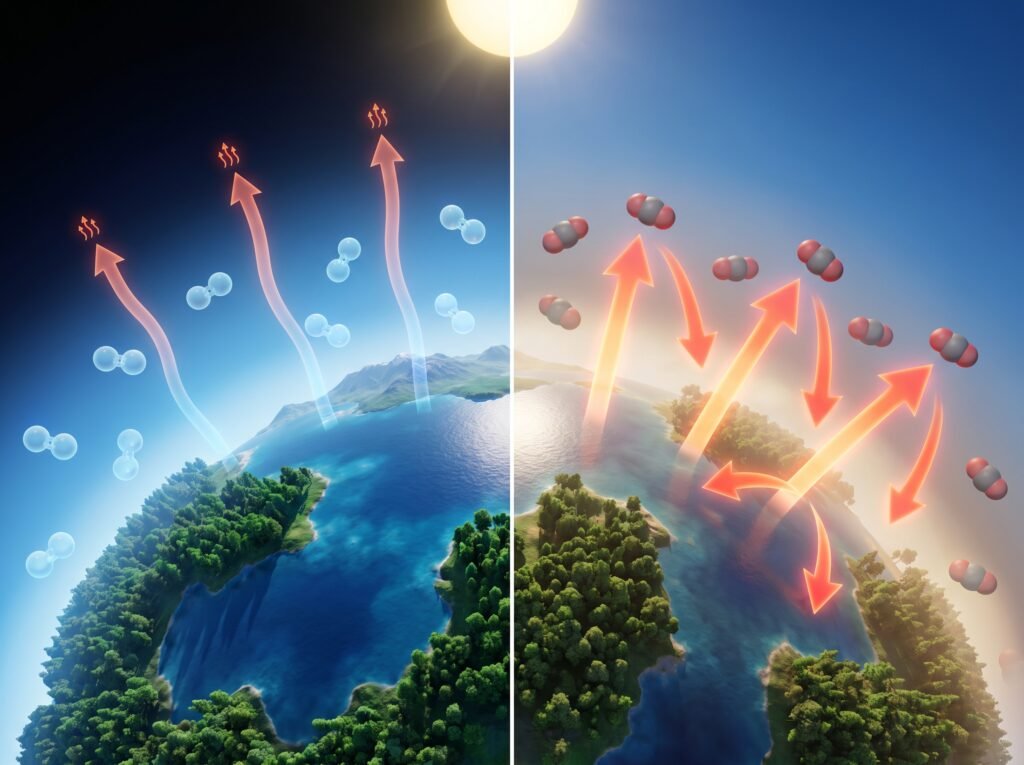
Carbon dioxide consists of one carbon atom bonded to two oxygen atoms.
Although it contains oxygen atoms, the complete CO₂ molecule behaves very differently from O₂.
Carbon dioxide has several vibration modes that interact strongly with infrared radiation.
When Earth emits heat, carbon dioxide absorbs specific wavelengths and re-emits them, trapping heat within the atmosphere.
Oxygen molecules cannot perform this function.
Therefore:
- Oxygen supports life.
- Carbon dioxide regulates Earth’s temperature.
- Excess carbon dioxide contributes to global warming.
- Oxygen does not significantly affect atmospheric warming.
This distinction often surprises people because oxygen is much more abundant than carbon dioxide.
Yet carbon dioxide has a far greater influence on climate.
Does Oxygen Affect Earth’s Temperature at All?
While oxygen is not a greenhouse gas, it still plays indirect roles in Earth’s climate system.
For example:
Plants produce oxygen during photosynthesis while removing carbon dioxide from the atmosphere.
Healthy forests increase oxygen production and reduce atmospheric CO₂.
Oxygen also supports respiration, decomposition, and combustion, processes that influence the carbon cycle.
However, oxygen itself does not directly warm Earth’s atmosphere.
Its role is primarily biological rather than climatic.
Oxygen and Photosynthesis
Plants, algae, and certain bacteria use sunlight to convert carbon dioxide and water into glucose.
During this process, oxygen is released as a by-product.
The simplified equation is:
Carbon Dioxide + Water + Sunlight → Glucose + Oxygen
This reaction removes carbon dioxide—a greenhouse gas—from the atmosphere while increasing oxygen levels.
Although oxygen produced by plants is essential for life, it does not increase global warming.
Instead, healthy ecosystems help regulate atmospheric carbon dioxide concentrations, making forests and oceans vital in combating climate change.
Why This Question Is So Common
The question “is oxygen a greenhouse gas“ has become increasingly popular because climate change discussions frequently mention atmospheric gases.
People naturally assume that any gas present in the atmosphere contributes to warming.
Others believe oxygen must trap heat because it is required for combustion.
In reality, combustion releases greenhouse gases like carbon dioxide, but oxygen itself simply supports the chemical reaction.
It is the products of combustion—not oxygen—that contribute to global warming.
Understanding this distinction helps eliminate one of the most common misconceptions about Earth’s atmosphere.
How Does the Greenhouse Effect Actually Work?
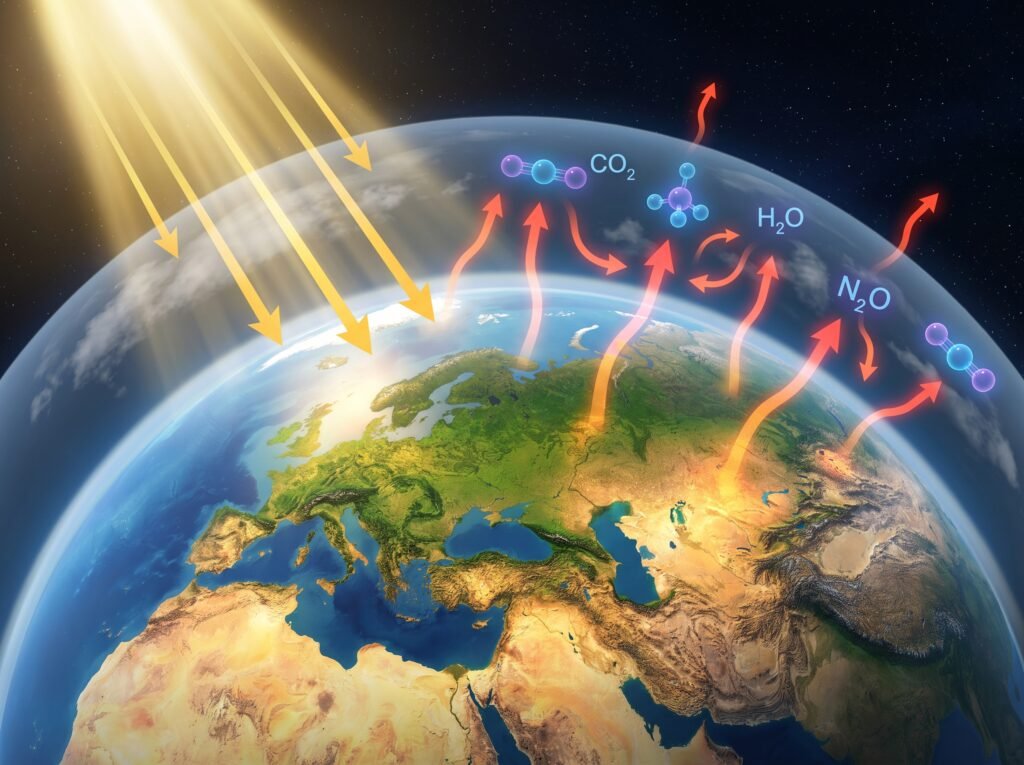
To fully understand is oxygen a greenhouse gas, it’s important to know exactly how the greenhouse effect works. The greenhouse effect is a natural process that keeps Earth warm enough for life. Without it, our planet would be an icy world where most plants, animals, and humans could not survive.
The process begins when the Sun emits energy toward Earth in the form of shortwave radiation. Most of this sunlight passes through the atmosphere without being absorbed. Earth’s land, oceans, forests, and other surfaces absorb much of this energy, warming the planet during the day.
As Earth’s surface heats up, it releases energy back toward space as longwave infrared radiation. If every bit of this heat escaped into space, Earth would become extremely cold every night. Fortunately, greenhouse gases absorb some of this outgoing infrared radiation and re-emit it in all directions, including back toward Earth’s surface. This process keeps the lower atmosphere warm and creates stable temperatures that allow life to thrive.
Oxygen behaves differently. Instead of absorbing infrared radiation, oxygen molecules allow most of this heat to pass through the atmosphere. Because oxygen cannot trap this outgoing heat, scientists do not classify it as a greenhouse gas.
Why Molecular Structure Determines Greenhouse Behavior
One of the biggest misconceptions about atmospheric gases is that the most abundant gases should have the biggest effect on climate. In reality, abundance has very little to do with whether a gas traps heat.
The key factor is molecular structure.
Every molecule vibrates in different ways. Some molecular vibrations interact with infrared radiation, while others do not.
Greenhouse gases have molecular vibration patterns that absorb Earth’s infrared radiation. When these molecules absorb heat, they temporarily store the energy before releasing it again. This repeated absorption and emission slows the escape of heat into space.
Oxygen molecules are much simpler. Since O₂ consists of two identical oxygen atoms bonded together, it lacks the vibration characteristics needed to absorb infrared radiation effectively.
This scientific property explains why oxygen has almost no greenhouse effect despite making up about one-fifth of Earth’s atmosphere.
Oxygen vs Carbon Dioxide: What’s the Difference?
Many people find it confusing that oxygen and carbon dioxide both contain oxygen atoms, yet only one is considered a greenhouse gas.
The answer lies in their molecular arrangement.
An oxygen molecule contains only two identical oxygen atoms.
A carbon dioxide molecule contains one carbon atom and two oxygen atoms arranged differently.
Because of this structure, carbon dioxide has several vibration modes that strongly absorb infrared radiation. Oxygen does not.
This is why carbon dioxide can trap heat while oxygen cannot.
Even though carbon dioxide represents only a tiny fraction of Earth’s atmosphere, it has a much greater influence on climate because of how its molecules interact with heat.
Comparing Oxygen with Other Atmospheric Gases
Earth’s atmosphere contains many gases, but they do not all perform the same functions.
Nitrogen (N₂) makes up about 78% of the atmosphere. Like oxygen, nitrogen does not absorb infrared radiation efficiently and is not considered a greenhouse gas.
Oxygen (O₂) accounts for approximately 21% of the atmosphere. It supports respiration, combustion, and many biological processes but contributes almost nothing to the greenhouse effect.
Argon (Ar) is another abundant atmospheric gas. It is chemically inactive and also does not trap heat.
Carbon Dioxide (CO₂) exists in much smaller concentrations but plays a major role in regulating Earth’s temperature.
Methane (CH₄) is present in even smaller amounts than carbon dioxide, yet molecule for molecule, methane traps significantly more heat over short time periods.
Water Vapor (H₂O) is the most abundant greenhouse gas and naturally changes depending on temperature and humidity.
This comparison clearly shows that being abundant does not automatically make a gas a greenhouse gas.
Why Water Vapor Is a Greenhouse Gas but Oxygen Isn’t
Water vapor often surprises people because it naturally exists in the atmosphere.
Unlike oxygen, water vapor has an uneven molecular structure.
This asymmetrical arrangement allows water molecules to absorb infrared radiation extremely well.
As a result, water vapor plays an important role in Earth’s greenhouse effect.
It also creates a positive feedback loop.
As carbon dioxide warms the atmosphere, more water evaporates.
The additional water vapor traps even more heat.
This amplifies warming but is not considered the initial cause of climate change.
Oxygen has no similar effect.
Regardless of atmospheric concentration, oxygen does not significantly absorb infrared radiation.
Is Oxygen Responsible for Global Warming?
The simple answer remains no.
Oxygen is not responsible for global warming.
Modern climate change is primarily caused by increasing concentrations of greenhouse gases produced through human activities.
These include:
- Burning coal
- Burning oil
- Burning natural gas
- Deforestation
- Industrial manufacturing
- Agriculture
- Livestock farming
- Landfills
These activities release large amounts of carbon dioxide, methane, and nitrous oxide.
Oxygen participates in combustion because fires require oxygen to burn.
However, oxygen itself is not the pollutant.
The greenhouse gases produced during combustion are what contribute to global warming.
Oxygen’s Role in the Carbon Cycle
Although oxygen is not a greenhouse gas, it plays a critical role in one of Earth’s most important natural systems—the carbon cycle.
The carbon cycle continuously moves carbon between the atmosphere, oceans, soil, plants, animals, and rocks.
Plants absorb carbon dioxide during photosynthesis.
Using sunlight, they convert carbon dioxide and water into sugars that fuel growth.
During this process, oxygen is released into the atmosphere.
Animals then breathe oxygen and release carbon dioxide during respiration.
This ongoing exchange has maintained Earth’s atmosphere for millions of years.
Human activities, however, have disrupted this balance by releasing carbon much faster than natural systems can absorb it.
Oxygen’s Importance for Life
Even though oxygen is not a greenhouse gas, it remains one of Earth’s most essential atmospheric components.
Every human breathes oxygen thousands of times every day.
Most animals depend on oxygen to survive.
Fish obtain dissolved oxygen from water.
Microorganisms use oxygen to break down organic matter.
Without oxygen, complex life on Earth would disappear.
Its primary role is biological rather than climatic.
While greenhouse gases regulate Earth’s temperature, oxygen supports nearly every living organism.
Common Myths About Oxygen and Greenhouse Gases
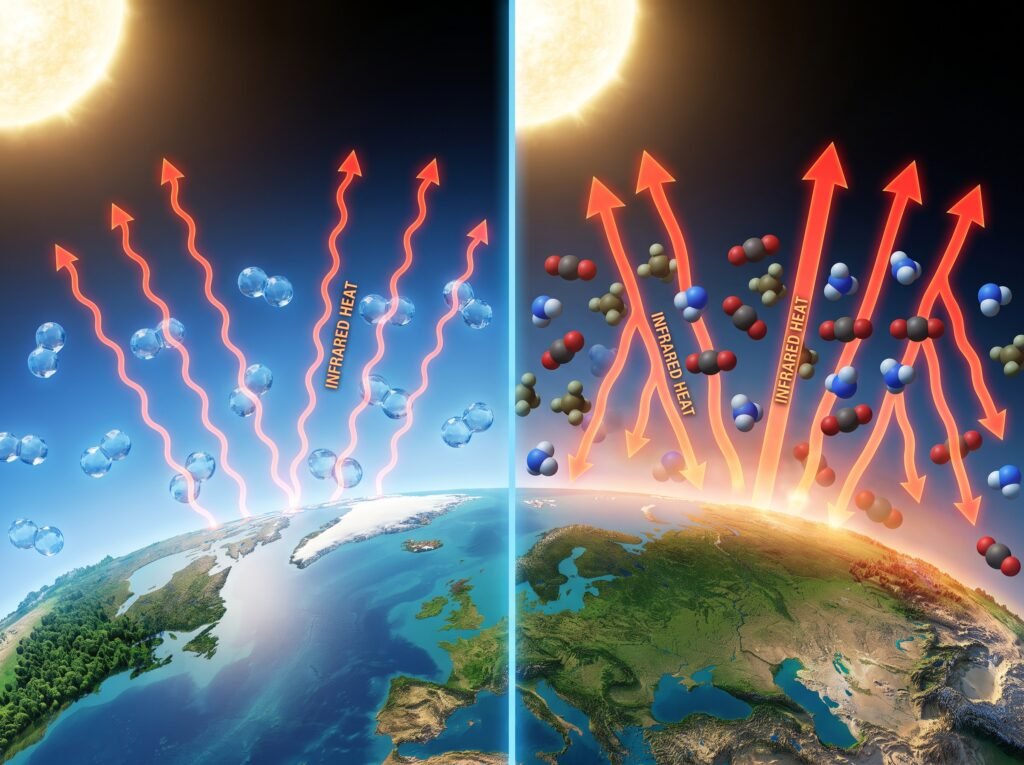
Because climate change receives so much media attention, many myths have spread online.
Let’s clear up several of the most common misunderstandings.
Myth 1: Oxygen Traps Heat
This is false.
Oxygen allows infrared radiation to pass through without significant absorption.
Myth 2: More Oxygen Causes Global Warming
There is no scientific evidence supporting this claim.
Increasing oxygen concentrations would not significantly increase Earth’s greenhouse effect.
Myth 3: Every Atmospheric Gas Is a Greenhouse Gas
Only gases that absorb infrared radiation qualify as greenhouse gases.
Most atmospheric gases—including oxygen and nitrogen—do not.
Myth 4: Carbon Dioxide Is Dangerous Only Because There’s So Much of It
Actually, carbon dioxide represents only a small fraction of the atmosphere.
Its warming effect comes from its molecular properties, not its abundance.
Myth 5: Plants Produce Greenhouse Gases Because They Produce Oxygen
Plants actually help reduce atmospheric carbon dioxide through photosynthesis.
Healthy forests remove carbon dioxide while releasing oxygen.
Why Scientists Focus on Carbon Dioxide Instead of Oxygen
When governments discuss reducing emissions, they almost always focus on carbon dioxide.
This is because carbon dioxide is the largest human-produced greenhouse gas.
Unlike oxygen, carbon dioxide absorbs infrared radiation efficiently.
Every time fossil fuels are burned, additional carbon dioxide enters the atmosphere.
Much of this carbon dioxide remains there for decades or even centuries.
This long lifetime allows greenhouse warming to accumulate over time.
Reducing carbon dioxide emissions is therefore one of the most effective ways to slow climate change.
Reducing oxygen emissions would make no scientific sense because oxygen is not causing the problem.
Real-World Examples That Make It Easy to Understand
Imagine wearing two different jackets on a cold day.
One jacket is thick and insulated.
The other is made of thin mesh fabric.
The insulated jacket traps body heat and keeps you warm.
The mesh jacket allows heat to escape easily.
Greenhouse gases behave like the insulated jacket.
Oxygen behaves like the mesh jacket.
Heat passes through oxygen without being trapped.
This simple analogy helps explain why oxygen cannot contribute significantly to Earth’s greenhouse effect.
What Would Happen If Earth Had No Greenhouse Gases?
This thought experiment highlights the importance of greenhouse gases.
If Earth had no greenhouse gases at all, nearly all outgoing infrared radiation would escape directly into space.
Average global temperatures would fall to around −18°C (0°F).
Most oceans would freeze.
Agriculture would collapse.
Most current ecosystems would disappear.
Natural greenhouse gases therefore make life possible.
The problem today is not the existence of greenhouse gases but the rapid increase in their concentrations due to human activities.
Oxygen plays no direct role in this warming process.
Why This Knowledge Matters
Understanding the answer to “is oxygen a greenhouse gas“ helps you interpret climate news more accurately and avoid common misconceptions. It also highlights the importance of focusing on the gases that truly influence Earth’s climate.
Instead of worrying about oxygen, scientists emphasize reducing emissions of carbon dioxide, methane, and nitrous oxide while protecting forests and oceans that naturally help regulate the atmosphere.
Frequently Asked Questions About Oxygen and Greenhouse Gases
People often search for “is oxygen a greenhouse gas” because they want a clear, science-based answer. While we’ve already explained that oxygen does not trap heat in the atmosphere like carbon dioxide or methane, there are still many related questions worth exploring. Below are some of the most common FAQs that help clarify oxygen’s role in Earth’s atmosphere and climate.
Is Oxygen a Greenhouse Gas?
No. Oxygen (O₂) is not a greenhouse gas because it does not absorb and re-emit infrared radiation. Greenhouse gases have unique molecular structures that allow them to trap heat in Earth’s atmosphere. Oxygen lacks these properties, so it contributes almost nothing to the greenhouse effect.
Why Do People Think Oxygen Is a Greenhouse Gas?
The confusion usually comes from the fact that oxygen makes up about 21% of Earth’s atmosphere. Many people assume that any major atmospheric gas must influence global warming. However, greenhouse behavior depends on a gas’s molecular structure—not on how much of it exists in the atmosphere.
Is Nitrogen a Greenhouse Gas?
No. Nitrogen (N₂), which makes up approximately 78% of Earth’s atmosphere, is also not a greenhouse gas. Like oxygen, nitrogen does not absorb infrared radiation effectively and therefore does not trap heat.
Which Gas Is the Most Important Greenhouse Gas?
Water vapor is the most abundant natural greenhouse gas. However, carbon dioxide is considered the most significant human-influenced greenhouse gas because its concentration has increased dramatically due to burning fossil fuels, deforestation, and industrial activities.
Does Breathing Oxygen Affect Climate Change?
Breathing oxygen does not contribute to climate change. Humans inhale oxygen and exhale carbon dioxide, but the carbon involved in normal respiration is part of the natural carbon cycle. Unlike fossil fuel emissions, respiration does not add “new” carbon to the atmosphere.
Can Increasing Oxygen Levels Reduce Global Warming?
Increasing atmospheric oxygen would not directly reduce global warming. The key to slowing climate change is reducing greenhouse gas emissions while protecting forests, wetlands, and oceans that naturally remove carbon dioxide from the atmosphere.
The Environmental Importance of Oxygen
Although oxygen is not a greenhouse gas, its environmental importance cannot be overstated. Every complex organism on Earth depends on oxygen to survive. Humans, mammals, birds, fish, insects, and countless microorganisms use oxygen for cellular respiration, a process that converts food into usable energy.
Plants are equally important in maintaining Earth’s oxygen supply. Through photosynthesis, they absorb carbon dioxide and release oxygen into the atmosphere. This remarkable process not only supports life but also helps regulate the concentration of carbon dioxide, one of the primary greenhouse gases.
Healthy forests, grasslands, wetlands, and marine ecosystems act as natural climate regulators. They absorb carbon dioxide while producing oxygen, making ecosystem conservation one of the most effective long-term strategies for protecting the environment.
How Human Activities Affect the Atmosphere
While oxygen itself remains relatively stable, human activities have dramatically changed the concentration of greenhouse gases.
Burning fossil fuels for electricity, transportation, and manufacturing releases billions of tons of carbon dioxide every year. Agriculture contributes methane and nitrous oxide, while deforestation reduces the number of trees available to absorb carbon dioxide through photosynthesis.
These activities strengthen the greenhouse effect, causing Earth’s average temperature to rise. Scientists have linked this warming to melting glaciers, rising sea levels, changing weather patterns, stronger heatwaves, and more frequent extreme weather events.
The focus of climate action is therefore not on oxygen but on reducing greenhouse gas emissions and improving the planet’s ability to naturally remove carbon dioxide.
Simple Ways Everyone Can Help Reduce Greenhouse Gas Emissions
Understanding the science behind greenhouse gases is only the first step. Everyone can make choices that help reduce emissions and protect the environment.
Using public transportation, cycling, or walking instead of driving whenever possible can reduce fossil fuel consumption. Improving home energy efficiency, switching to renewable energy sources, and reducing unnecessary electricity use also lower carbon emissions.
Planting trees remains one of the simplest and most effective environmental actions. Trees absorb carbon dioxide while releasing oxygen, making them valuable allies in combating climate change.
Reducing food waste, recycling materials, supporting sustainable farming practices, and choosing energy-efficient appliances can also make a positive difference over time.
While individual actions alone cannot solve climate change, millions of small improvements collectively contribute to a healthier planet.
Common Climate Change Misconceptions
Climate science is sometimes misunderstood, leading to myths that spread quickly online. Here are a few important facts:
One common misconception is that oxygen causes global warming because fires require oxygen to burn. In reality, oxygen simply supports combustion. The greenhouse gases produced during burning—especially carbon dioxide—are what contribute to warming.
Another myth is that because carbon dioxide is only a tiny fraction of the atmosphere, it cannot significantly affect climate. Scientific research clearly shows that even small increases in greenhouse gas concentrations can have large effects because of their ability to absorb infrared radiation.
Some people also believe that planting trees alone will completely solve climate change. While forests are incredibly valuable, reducing greenhouse gas emissions remains equally important because emissions currently exceed the natural capacity of ecosystems to absorb carbon.
Understanding these differences helps separate scientific evidence from misinformation.
The Scientific Consensus
Climate scientists around the world agree on several key facts:
- Oxygen is not a greenhouse gas.
- Nitrogen is not a greenhouse gas.
- Carbon dioxide, methane, nitrous oxide, water vapor, and ozone contribute to the greenhouse effect.
- Human activities have increased greenhouse gas concentrations since the Industrial Revolution.
- Reducing greenhouse gas emissions is essential for slowing global warming.
These conclusions are supported by decades of atmospheric observations, laboratory experiments, satellite measurements, and climate models.
Is Oxygen a Greenhouse Gas? Final Verdict
So, is oxygen a greenhouse gas?
The answer is no.
Although oxygen is one of the most abundant gases in Earth’s atmosphere and is essential for nearly all forms of life, it does not absorb infrared radiation in the way greenhouse gases do. Because it cannot effectively trap heat, oxygen plays almost no direct role in the greenhouse effect.
Instead, oxygen supports respiration, combustion, and countless biological processes that make life on Earth possible. Greenhouse gases such as carbon dioxide, methane, water vapor, nitrous oxide, and ozone are responsible for trapping heat and maintaining Earth’s temperature.
Understanding this distinction helps explain why climate scientists focus on reducing greenhouse gas emissions rather than changing atmospheric oxygen levels.
The next time someone asks “is oxygen a greenhouse gas?”, you’ll know the scientific answer—and the reasons behind it.
Conclusion
Earth’s atmosphere is a carefully balanced system where every gas has a unique role. Oxygen keeps living organisms alive, nitrogen provides atmospheric stability, and greenhouse gases maintain temperatures suitable for life. The challenge facing humanity today is not oxygen but the increasing concentration of greenhouse gases caused by human activities.
Learning how the atmosphere works empowers us to make informed decisions about energy use, conservation, and environmental responsibility. By reducing greenhouse gas emissions, protecting forests, and supporting sustainable practices, we can help preserve a stable climate for future generations.
Remember, understanding science is the first step toward protecting our planet.
Ready to Learn More?
If you found this guide helpful, explore our other in-depth greenhouse and climate articles. Whether you’re a student, gardener, environmental enthusiast, or simply curious about how Earth’s atmosphere works, you’ll find practical, easy-to-understand resources designed to answer your biggest questions.
Share this article with friends, bookmark it for future reference, and leave a comment below with your thoughts or questions. Your support helps us create more high-quality environmental guides that make science simple and accessible for everyone.